Pyle at a glance
- Postcode districts
- CF33
- Population
- about 13,701 (GeoNames)
- Council area
- Bridgend County Borough Council
- Building approval
- Bridgend County Borough Council building control, or a registered building control approver
- Nearest main town
- Bridgend, about 5 miles
- Guide price region
- Wales (−8% on West Midlands rates)
Why choose single-ply roofing in Pyle?
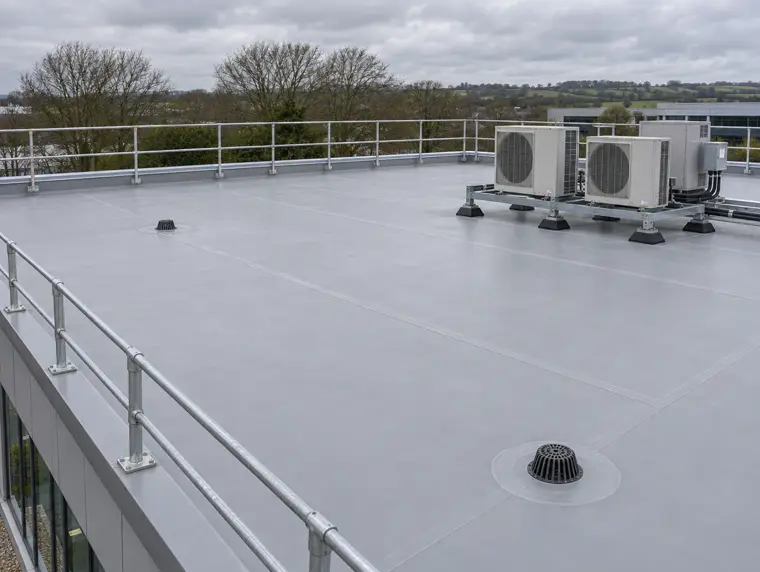
Single-ply often suits blocks and mixed-use buildings in Pyle because no flame is used on the roof, which can make work around residents and businesses easier to plan. Hot-air welding still needs care, but the fire risk is lower than with torch-on.
Pyle's flat roofs are mostly on 1930s semis with flat-roofed garages and kitchen extensions, with plenty on terraced streets with flat-roofed rear kitchens and bathrooms too. Wales averages roughly 1,460 mm of rain a year, among the wettest in Britain, so we design for steady run-off: proper falls, clear outlets and upstands well above the finished roof.
How much does a single-ply roof cost in Pyle?
At Wales guide rates, a 100 m² commercial roof in single-ply with insulation comes to £12,150–£20,050 including VAT. The fixed price comes after a free survey for new and replacement roofs.
| Job | Guide price inc VAT |
|---|---|
| Commercial roof (100 m²), single-ply + insulation | £12,150–£20,050 |
| Single garage (18 m²), single-ply | £1,900–£3,050 |
| Single garage (18 m²), EPDM rubber | £1,450–£2,600 |
| Extension (20 m²), EPDM, new deck + insulation | £2,600–£4,500 |
What insulation and approvals does a single-ply re-roof need?
On a heated building, a full single-ply re-roof usually triggers the thermal-element rules, so insulation should be brought towards the renovation standard where feasible. In England that is 0.18 W/m²K for non-domestic and 0.16 W/m²K for domestic roofs, with Wales and Northern Ireland setting their own figures; Scottish roofs follow Section 6 of the building standards, and the council confirms whether a building warrant is required.
Single-ply suits a warm roof well, and tapered insulation can correct poor falls at the same time. A thicker build-up raises the roof, so we check upstand heights, door thresholds and rooflight kerbs at survey. Near boundaries, the external fire classification of the tested build-up can matter. We handle building control or building standards where needed; see the building regulations page.
What's included?
- Welded details at upstands, outlets, rooflight kerbs and edge trims
- Strip-out or preparation of the existing roof, with waste removed
- Edge protection on every job and walkway protection around plant
- Vapour control layer and warm-roof or tapered insulation as specified
Building regulations in Wales
The Welsh Approved Document L applies. Renovating more than half of a roof over a heated room means upgrading it to around 0.16 W/m²K where feasible, and new extension roofs are built to 0.13 W/m²K. Welsh Government guidance is that most re-roofing needs building control approval, so check whenever more than a quarter of a roof is replaced or repaired. We deal with the application as part of the job. More on the rules.
Which nearby areas do we also cover?
Single-ply membrane roofing in Pyle: questions
Do you cover Pyle?
Yes. Pyle is part of our Bridgend coverage, including postcode districts CF33. Surveys and roofs are carried out by vetted roofing teams working under S&K Property Investments and Improvement Ltd.
Who checks building regulations for a flat roof in Pyle?
Where the work needs approval it goes to Bridgend County Borough Council building control, or a registered building control approver. We tell you at the survey whether your job needs it and deal with the paperwork as part of the quote.
How much does a single-ply roof cost in Pyle?
£12,150–£20,050 for a 100 m² commercial roof in single-ply with insulation, at Wales guide rates including VAT. The fixed price comes after a free survey for new and replacement roofs.
How long does a commercial single-ply roof take?
A roof of around 100 m² typically takes several days, depending on strip-out, insulation, details and weather. Work is phased so the building stays weathertight and occupied areas are protected.
Can single-ply be used on a house?
Yes. It can be used on garages, extensions and dormers, usually adhered rather than mechanically fixed. On small domestic roofs, though, EPDM or GRP is often more economical.