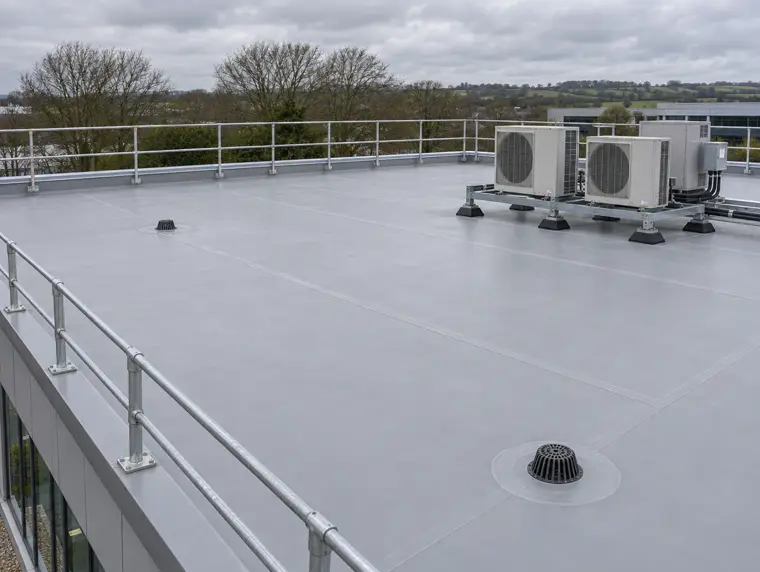
- Price per m²
- £83–£133
- Typical life
- 25–35+ years
- Manufacturer guarantees
- 20–25 year guarantees on specified systems
- Typical garage roof
- £1,900–£3,050
Monmouthshire at a glance
- Largest towns
- Abergavenny, Chepstow, Monmouth, Caldicot
- Postcode areas
- NP
- Building control
- Monmouthshire County Council
- Neighbouring areas
- Torfaen · Newport · Caerphilly · Blaenau Gwent
- Guide price region
- Wales (−8% on West Midlands rates)
How much does a single-ply roof cost in Monmouthshire?
Guide prices including VAT at Wales rates. The fixed price comes after a free survey for new and replacement roofs.
| Job | Guide price inc VAT |
|---|---|
| Commercial roof (100 m²), single-ply + insulation | £12,150–£20,050 |
| Single garage (18 m²), single-ply | £1,900–£3,050 |
| Single garage (18 m²), EPDM rubber | £1,450–£2,600 |
| Extension (20 m²), EPDM, new deck + insulation | £2,600–£4,500 |
Which flat roofs are common in Monmouthshire?
Flat roofs in Monmouthshire sit on lock-up garage blocks on estates, terraced streets with flat-roofed rear kitchens and bathrooms and newer estates where the first extension roofs are now being replaced. Wales averages roughly 1,460 mm of rain a year, among the wettest in Britain, so we design for steady run-off: proper falls, clear outlets and upstands well above the finished roof. Approximate 1991–2020 regional averages based on Met Office data.
Building regulations in Wales
Welsh guidance is that most re-roofing needs building control approval, so it's worth checking whenever more than a quarter of a roof is replaced or repaired. Renovated roofs are upgraded to around 0.16 W/m²K where feasible, and new extension roofs are built to 0.13 W/m²K under the Welsh Approved Document L. In Monmouthshire the application goes to Monmouthshire County Council. More on the rules.
What insulation and approvals does a single-ply re-roof need?
On a heated building, a full single-ply re-roof usually triggers the thermal-element rules, so insulation should be brought towards the renovation standard where feasible. In England that is 0.18 W/m²K for non-domestic and 0.16 W/m²K for domestic roofs, with Wales and Northern Ireland setting their own figures; Scottish roofs follow Section 6 of the building standards, and the council confirms whether a building warrant is required.
Single-ply suits a warm roof well, and tapered insulation can correct poor falls at the same time. A thicker build-up raises the roof, so we check upstand heights, door thresholds and rooflight kerbs at survey. Near boundaries, the external fire classification of the tested build-up can matter. We handle building control or building standards where needed; see the building regulations page.
Should a single-ply roof be mechanically fixed or adhered, and how are the seams welded?
Most commercial single-ply roofs are mechanically fixed, while adhered systems suit decks that cannot take fixings or roofs where a smooth finish is wanted. The choice depends on the deck, the wind exposure of the site and the manufacturer's specification.
| Method | How it works | Typical use |
|---|---|---|
| Mechanically fixed | Fasteners and plates hold the membrane through the insulation into the deck, hidden under the lap of the next sheet | Metal, timber and concrete decks on commercial roofs |
| Adhered | Membrane bonded to the insulation or deck with adhesive | Domestic roofs, roofs where fixings are unsuitable |
| Ballasted | Loose-laid and held down by paving, gravel or a green roof | Inverted roofs, terraces, green roofs |
Fixing patterns are worked out for the site, with more fasteners at corners and perimeters, where wind uplift is strongest.
Seams are welded by hot-air machines and hand tools that melt the overlapping edges so they fuse. Each seam is then probed along its length to find any gaps, and test welds are made at the start of the day to set the machine for the weather. On commercial jobs we also check that walkways protect the membrane around plant.
Which towns in Monmouthshire do we cover?
Single-ply membrane roofing in Monmouthshire: questions
Which towns in Monmouthshire do you cover?
All of Monmouthshire. The main towns have their own pages below, and if yours isn't listed we still cover it: send your postcode and we'll confirm.
How much does a single-ply roof cost in Monmouthshire?
£12,150–£20,050 for a 100 m² commercial roof in single-ply with insulation, at Wales guide rates including VAT. The fixed price comes after a free survey for new and replacement roofs.
Which postcode areas do you cover in Monmouthshire?
All of Monmouthshire, including the NP postcode areas. Send your full postcode and we'll confirm.
How long does a commercial single-ply roof take?
A roof of around 100 m² typically takes several days, depending on strip-out, insulation, details and weather. Work is phased so the building stays weathertight and occupied areas are protected.
Does single-ply work with solar panels or a green roof?
Usually, yes. Many systems can be specified for sedum or ballasted green roofs, and solar mounts can be welded or ballasted, though the structure and wind loads must be checked first.
What is the difference between PVC and TPO roofing?
Both are thermoplastic single-ply membranes welded with hot air. PVC contains plasticisers and usually needs separating from bitumen, while TPO and FPO are polyolefin-based; the right one depends on the roof and the system specified.
Everything about single-ply membrane roofing → · All flat roofing in Monmouthshire →