Salisbury at a glance
- Postcode districts
- SP1, SP2
- Population
- about 44,748 (GeoNames)
- Council area
- Wiltshire Council
- Building approval
- Wiltshire Council building control, or a registered building control approver
- Guide price region
- South West (+3% on West Midlands rates)
Why choose single-ply roofing in Salisbury?
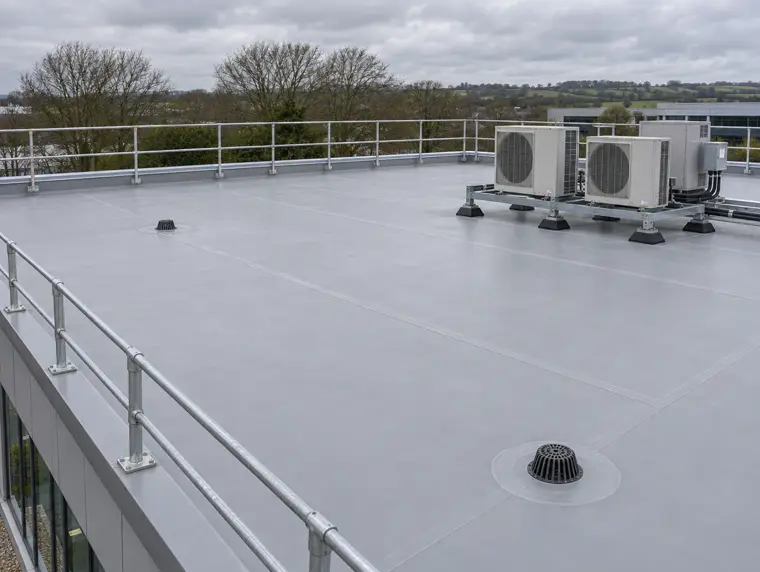
On exposed sites in Salisbury and elsewhere, mechanically fixed single-ply is specified with a fixing pattern based on wind uplift, with extra fasteners at corners and edges. That makes it a strong option for commercial roofs where wind loads are a concern.
Salisbury's flat roofs are mostly on newer estates where the first extension roofs are now being replaced, with plenty on 1960s and 1970s link-detached houses with flat-roofed garages and porches too. The South West averages roughly 1,260 mm of rain a year and many roofs face wind off the Atlantic, so we specify fixings and edge details for wind uplift as well as drainage.
How much does a single-ply roof cost in Salisbury?
For Salisbury we use South West rates: £13,650–£22,450 is the guide for a 100 m² commercial roof in single-ply with insulation, VAT included. The fixed price comes after a free survey for new and replacement roofs.
| Job | Guide price inc VAT |
|---|---|
| Commercial roof (100 m²), single-ply + insulation | £13,650–£22,450 |
| Single garage (18 m²), single-ply | £2,100–£3,450 |
| Single garage (18 m²), EPDM rubber | £1,650–£2,900 |
| Extension (20 m²), EPDM, new deck + insulation | £2,900–£5,050 |
What insulation and approvals does a single-ply re-roof need?
On a heated building, a full single-ply re-roof usually triggers the thermal-element rules, so insulation should be brought towards the renovation standard where feasible. In England that is 0.18 W/m²K for non-domestic and 0.16 W/m²K for domestic roofs, with Wales and Northern Ireland setting their own figures; Scottish roofs follow Section 6 of the building standards, and the council confirms whether a building warrant is required.
Single-ply suits a warm roof well, and tapered insulation can correct poor falls at the same time. A thicker build-up raises the roof, so we check upstand heights, door thresholds and rooflight kerbs at survey. Near boundaries, the external fire classification of the tested build-up can matter. We handle building control or building standards where needed; see the building regulations page.
What's included?
- Welded details at upstands, outlets, rooflight kerbs and edge trims
- Vapour control layer and warm-roof or tapered insulation as specified
- Hot-air welded seams, each probed along its full length
- Edge protection on every job and walkway protection around plant
Building regulations in England
Replacing more than half of a flat roof over a heated room usually counts as renovating a thermal element, so the roof is insulated to around 0.16 W/m²K where that's technically and economically feasible, and the work is notified to building control: the council or a registered building control approver, unless a registered competent person self-certifies it. A roof on a new extension is built to 0.15 W/m²K. Patch repairs, and most unheated detached garages, don't trigger the upgrade. Structural changes, or a new covering that adds 15% or more to the roof's weight, also need approval. More on the rules.
Which nearby areas do we also cover?
Single-ply membrane roofing in Salisbury: questions
Do you cover Salisbury?
Yes. Salisbury is part of our Wiltshire coverage, including postcode districts SP1, SP2. Surveys and roofs are carried out by vetted roofing teams working under S&K Property Investments and Improvement Ltd.
Who checks building regulations for a flat roof in Salisbury?
Where the work needs approval it goes to Wiltshire Council building control, or a registered building control approver. We tell you at the survey whether your job needs it and deal with the paperwork as part of the quote.
How much does a single-ply roof cost in Salisbury?
£13,650–£22,450 for a 100 m² commercial roof in single-ply with insulation, at South West guide rates including VAT. The fixed price comes after a free survey for new and replacement roofs.
What is the difference between PVC and TPO roofing?
Both are thermoplastic single-ply membranes welded with hot air. PVC contains plasticisers and usually needs separating from bitumen, while TPO and FPO are polyolefin-based; the right one depends on the roof and the system specified.
Can single-ply be used on a house?
Yes. It can be used on garages, extensions and dormers, usually adhered rather than mechanically fixed. On small domestic roofs, though, EPDM or GRP is often more economical.