Ascot at a glance
- Postcode districts
- SL5
- Population
- about 17,899 (GeoNames)
- Council area
- Royal Borough of Windsor and Maidenhead
- Building approval
- Royal Borough of Windsor and Maidenhead building control, or a registered building control approver
- Nearest main town
- Bracknell, about 3 miles
- Guide price region
- South East (+10% on West Midlands rates)
Why choose torch-on felt roofing in Ascot?
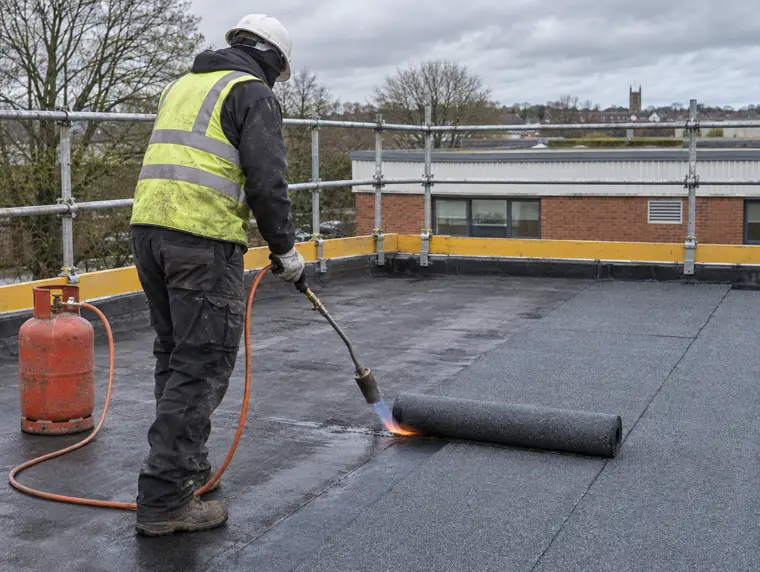
Torch-on felt is widely specified for blocks of flats and HMOs, in Ascot as elsewhere, because the system is well understood, widely repairable and governed by a British Standard code of practice. Three-layer builds with insulation are common on larger, multi-occupied roofs.
Ascot's flat roofs are mostly on low-rise post-war blocks of flats, with plenty on terraced streets with flat-roofed rear kitchens and bathrooms too. Much of the South East sits in the drier Thames catchment at roughly 730 mm of rain a year, so the usual failures are at joints, upstands and outlets rather than from sheer volume of rain.
How much does a torch-on felt roof cost in Ascot?
For Ascot we use South East rates: £1,650–£2,900 is the guide for a typical 18 m² garage roof in torch-on felt, VAT included. The fixed price comes after a free survey for new and replacement roofs.
| Job | Guide price inc VAT |
|---|---|
| Single garage (18 m²), torch-on felt | £1,650–£2,900 |
| Extension (20 m²), felt, new deck + insulation | £3,000–£5,150 |
| Block of flats (150 m²), felt + insulation + scaffold | £17,100–£29,900 |
| Single garage (18 m²), EPDM rubber | £1,750–£3,100 |
| Extension (20 m²), EPDM, new deck + insulation | £3,100–£5,350 |
Is torch-on roofing safe, and what is the difference between two- and three-layer systems?
Yes, torch-on is safe when hot works are properly controlled, because most roof fires linked to torching start at hidden timber or debris near edges and upstands, not on the open roof. Our teams follow a hot-works routine on every job:
- check eaves, fascias, soffits and wall cavities for timber, nests and debris before lighting a torch;
- use a cold-applied or self-adhesive membrane, rather than a flame, at edges, against combustible materials and in tight details;
- keep fire extinguishers on the roof and the gas bottles secured and away from the work;
- stop torching well before the team leaves, then carry out a fire watch so smouldering is spotted while people are still on site.
As for layers, a two-layer system (underlay plus cap sheet) is common on domestic roofs such as garages and extensions. A three-layer system adds an intermediate sheet, giving more thickness and redundancy, and is often specified on larger, commercial and multi-occupied roofs. The right choice depends on the size and use of the roof and the system's requirements, so we set it out in the quote.
Near a boundary, the external fire performance of the tested build-up, such as a BROOF(t4) classification, can also matter, and we check it where it applies.
What's included?
- Two- or three-layer reinforced bitumen membrane with staggered laps
- Hot-works checks and fire watch on every torch-on job
- Vapour control layer and warm-roof insulation where needed
- Strip-off of the existing roof covering and removal of waste
Building regulations in England
Replacing more than half of a flat roof over a heated room usually counts as renovating a thermal element, so the roof is insulated to around 0.16 W/m²K where that's technically and economically feasible, and the work is notified to building control: the council or a registered building control approver, unless a registered competent person self-certifies it. A roof on a new extension is built to 0.15 W/m²K. Patch repairs, and most unheated detached garages, don't trigger the upgrade. Structural changes, or a new covering that adds 15% or more to the roof's weight, also need approval. More on the rules.
Which nearby areas do we also cover?
Torch-on felt roofing in Ascot: questions
Do you cover Ascot?
Yes. Ascot is part of our Berkshire coverage, including postcode districts SL5. Surveys and roofs are carried out by vetted roofing teams working under S&K Property Investments and Improvement Ltd.
Who checks building regulations for a flat roof in Ascot?
Where the work needs approval it goes to Royal Borough of Windsor and Maidenhead building control, or a registered building control approver. We tell you at the survey whether your job needs it and deal with the paperwork as part of the quote.
How much does a torch-on felt roof cost in Ascot?
£1,650–£2,900 for a typical 18 m² garage roof in torch-on felt, at South East guide rates including VAT. The fixed price comes after a free survey for new and replacement roofs.
How long does it take to lay a torch-on felt roof?
A garage roof typically takes one to two days and an insulated extension two to three. Larger roofs and blocks are phased over longer, with each area made weathertight before the team leaves.
Is torch-on felt better than the old felt roofs?
Yes, considerably. Modern torch-on membranes are polymer-modified and polyester-reinforced, laid in bonded layers, and typically last much longer than the older felt systems they replace.