- Price per m²
- £53–£92
- Typical life
- 15–25 years
- Manufacturer guarantees
- 10–20 year material guarantees on specified systems
- Typical garage roof
- £1,350–£2,300
County Fermanagh at a glance
- Largest towns
- Enniskillen
- Postcode areas
- BT
- Building control
- Fermanagh and Omagh District Council
- Neighbouring areas
- County Tyrone · County Armagh · County Londonderry · County Antrim
- Guide price region
- Northern Ireland (−12% on West Midlands rates)
How much does a torch-on felt roof cost in County Fermanagh?
Guide prices including VAT at Northern Ireland rates. The fixed price comes after a free survey for new and replacement roofs.
| Job | Guide price inc VAT |
|---|---|
| Single garage (18 m²), torch-on felt | £1,350–£2,300 |
| Extension (20 m²), felt, new deck + insulation | £2,400–£4,100 |
| Block of flats (150 m²), felt + insulation + scaffold | £13,700–£23,950 |
| Single garage (18 m²), EPDM rubber | £1,400–£2,450 |
| Extension (20 m²), EPDM, new deck + insulation | £2,450–£4,300 |
Which flat roofs are common in County Fermanagh?
Flat roofs in County Fermanagh sit on newer estates where the first extension roofs are now being replaced, 1960s and 1970s link-detached houses with flat-roofed garages and porches and bungalows with flat-roofed side extensions and dormers. Northern Ireland averages roughly 1,150 mm of rain a year, spread over many wet days, so a roof that sheds water quickly to clear outlets lasts far longer than one that holds puddles. Approximate 1991–2020 regional averages based on Met Office data.
Building control in Northern Ireland
In Northern Ireland, renovating or replacing a roof over a heated room usually means meeting Technical Booklet F1, and building control should be contacted before work starts. Technical Booklet F1 sets roof insulation at 0.18 W/m²K when a roof over a heated room is renovated or newly built, where feasible. In County Fermanagh the application goes to Fermanagh and Omagh District Council. More on the rules.
Should I choose torch-on felt or a different flat roof system?
Choose torch-on felt when you want a proven, layered system at a sensible price, particularly on larger roofs, blocks of flats and commercial buildings where several layers give useful redundancy. It is a weaker choice where hot works are hard to manage safely.
For: generally lower cost per square metre; two or three layers, so a single defect in one layer need not cause a leak; tough mineral finish; long track record and a British Standard code of practice; repairs can be made with compatible materials.
Against: needs a naked flame unless a cold-applied or self-adhesive alternative is used; shorter typical life than EPDM or GRP; the finish is functional rather than decorative; more laps to detail than a single sheet.
On small domestic roofs near timber, EPDM avoids the torch entirely. GRP gives a harder, neater surface. For an overlay, a liquid-applied system is often simpler. Large commercial roofs may suit single-ply, and older buildings may suit mastic asphalt. See our comparison guide.
Is torch-on roofing safe, and what is the difference between two- and three-layer systems?
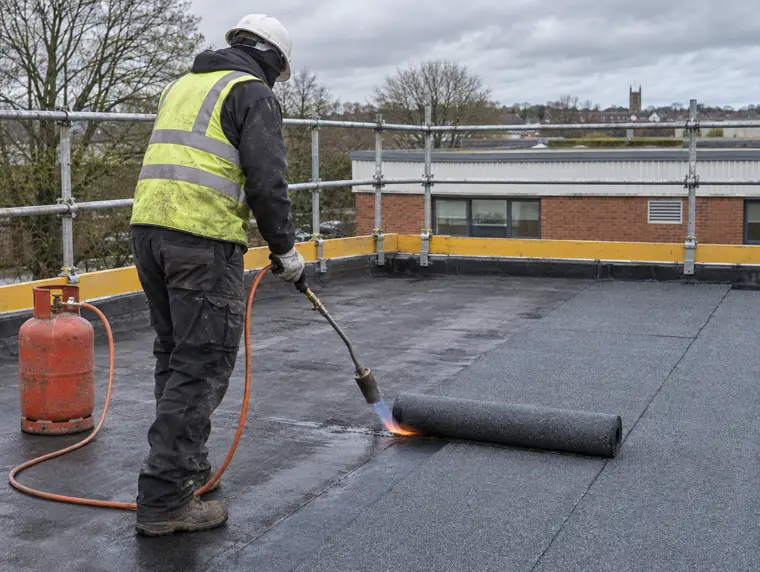
Yes, torch-on is safe when hot works are properly controlled, because most roof fires linked to torching start at hidden timber or debris near edges and upstands, not on the open roof. Our teams follow a hot-works routine on every job:
- check eaves, fascias, soffits and wall cavities for timber, nests and debris before lighting a torch;
- use a cold-applied or self-adhesive membrane, rather than a flame, at edges, against combustible materials and in tight details;
- keep fire extinguishers on the roof and the gas bottles secured and away from the work;
- stop torching well before the team leaves, then carry out a fire watch so smouldering is spotted while people are still on site.
As for layers, a two-layer system (underlay plus cap sheet) is common on domestic roofs such as garages and extensions. A three-layer system adds an intermediate sheet, giving more thickness and redundancy, and is often specified on larger, commercial and multi-occupied roofs. The right choice depends on the size and use of the roof and the system's requirements, so we set it out in the quote.
Near a boundary, the external fire performance of the tested build-up, such as a BROOF(t4) classification, can also matter, and we check it where it applies.
Which towns in County Fermanagh do we cover?
Torch-on felt roofing in County Fermanagh: questions
Which towns in County Fermanagh do you cover?
All of County Fermanagh. The main towns have their own pages below, and if yours isn't listed we still cover it: send your postcode and we'll confirm.
How much does a torch-on felt roof cost in County Fermanagh?
£1,350–£2,300 for a typical 18 m² garage roof in torch-on felt, at Northern Ireland guide rates including VAT. The fixed price comes after a free survey for new and replacement roofs.
Which council handles building control for a flat roof in County Fermanagh?
It depends on where the roof is: in County Fermanagh that's Fermanagh and Omagh District Council. In Northern Ireland, renovating or replacing a roof over a heated room usually means meeting Technical Booklet F1, and building control should be contacted before work starts. We confirm which applies at the survey.
How long does it take to lay a torch-on felt roof?
A garage roof typically takes one to two days and an insulated extension two to three. Larger roofs and blocks are phased over longer, with each area made weathertight before the team leaves.
Can torch-on felt go over an existing felt roof?
Sometimes, if the old roof is dry, well bonded and the deck is sound. Often stripping is better, because overlaying can trap moisture and hide rot; our guide to overlay or strip explains how we decide.
Can torch-on felt be laid in wet weather?
Not in rain or on a wet deck, because moisture trapped under the membrane causes blisters. Light cold weather is usually workable, but we will postpone rather than lay on a damp surface.
Everything about torch-on felt roofing → · All flat roofing in County Fermanagh →