Burry Port at a glance
- Postcode districts
- SA16
- Population
- about 8,310 (GeoNames)
- Council area
- Carmarthenshire County Council
- Building approval
- Carmarthenshire County Council building control, or a registered building control approver
- Nearest main town
- Llanelli, about 4 miles
- Guide price region
- Wales (−8% on West Midlands rates)
Why upgrade to a warm roof in Burry Port?
Landlords with flats and HMOs in Burry Port sometimes hear from tenants about cold top-floor rooms and black mould on ceilings. A warm roof upgrade during re-roofing tackles both the heat loss and the condensation behind the mould, and helps keep the roof timbers dry.
Burry Port's flat roofs are mostly on low-rise post-war blocks of flats, with plenty on newer estates where the first extension roofs are now being replaced too. Wales averages roughly 1,460 mm of rain a year, among the wettest in Britain, so we design for steady run-off: proper falls, clear outlets and upstands well above the finished roof.
How much does a warm roof upgrade cost in Burry Port?
Guide price in Burry Port: £2,600–£4,500 for a 20 m² extension roof in EPDM with a new deck and insulation, including VAT at Wales rates. The fixed price comes after a free survey for new and replacement roofs.
| Job | Guide price inc VAT |
|---|---|
| Extension (20 m²), EPDM, new deck + insulation | £2,600–£4,500 |
| Extension (20 m²), EPDM with sedum green roof | £4,050–£7,450 |
Can a cold flat roof be converted to a warm roof?
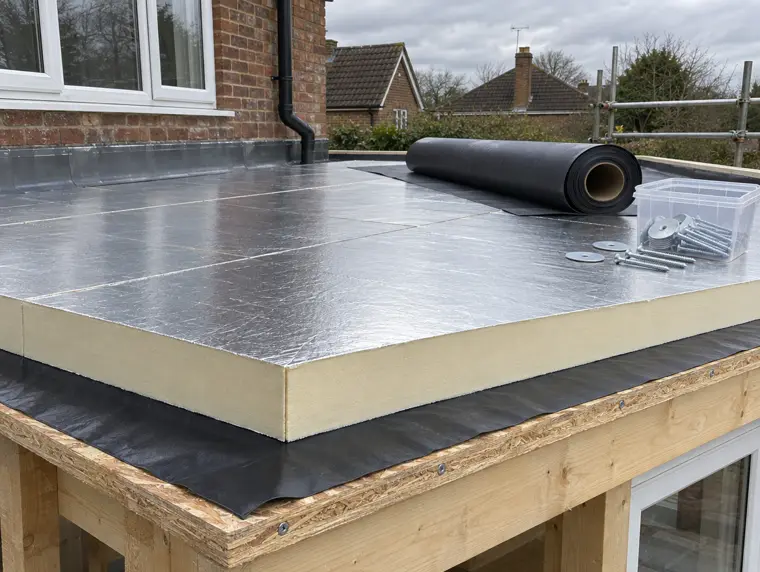
Yes, and it is the usual approach when an older cold roof is re-covered. The old covering is stripped, the deck is checked and replaced where needed, and the vapour control layer, insulation and new waterproofing go on top.
The existing insulation between the joists is assessed at the same time. Leaving it in place can create a cold, unventilated gap that traps moisture, so it is often removed or the build-up is designed so that most of the insulation sits above the deck. We decide this case by case once we can see inside the roof. If the covering is still sound and you are only patching it, the upgrade isn't usually required, and our repair or replace guide explains how to decide between the two.
What's included?
- Rigid insulation boards sized to the U-value target
- Survey of the deck, joists and existing insulation
- Upstands, trims and kerbs reset to the new roof level
- Building control or building standards handled where needed
Building regulations in Wales
The Welsh Approved Document L applies. Renovating more than half of a roof over a heated room means upgrading it to around 0.16 W/m²K where feasible, and new extension roofs are built to 0.13 W/m²K. Welsh Government guidance is that most re-roofing needs building control approval, so check whenever more than a quarter of a roof is replaced or repaired. We deal with the application as part of the job. More on the rules.
Which nearby areas do we also cover?
Warm roof insulation upgrades in Burry Port: questions
Do you cover Burry Port?
Yes. Burry Port is part of our Carmarthenshire coverage, including postcode districts SA16. Surveys and roofs are carried out by vetted roofing teams working under S&K Property Investments and Improvement Ltd.
Who checks building regulations for a flat roof in Burry Port?
Where the work needs approval it goes to Carmarthenshire County Council building control, or a registered building control approver. We tell you at the survey whether your job needs it and deal with the paperwork as part of the quote.
How much does a warm roof upgrade cost in Burry Port?
£2,600–£4,500 for a 20 m² extension roof in EPDM with a new deck and insulation, at Wales guide rates including VAT. The fixed price comes after a free survey for new and replacement roofs.
Is a warm roof worth it on a garage?
On a detached, unheated garage, usually not, as there is no heated space to protect and the thermal rules don't normally apply. On an integral or heated garage, or one being converted into a room, it is.
How thick does flat roof insulation need to be?
It depends on the insulation product and the U-value target. With common PIR boards, meeting a renovation target usually means well over 100 mm. Thinner, higher-performance boards are available where height is tight.