Carryduff at a glance
- Postcode districts
- BT8
- Population
- about 7,798 (GeoNames)
- Council area
- Lisburn and Castlereagh City Council
- Building approval
- Lisburn and Castlereagh City Council building control
- Nearest main town
- Belfast, about 6 miles
- Guide price region
- Northern Ireland (−12% on West Midlands rates)
Why upgrade to a warm roof in Carryduff?
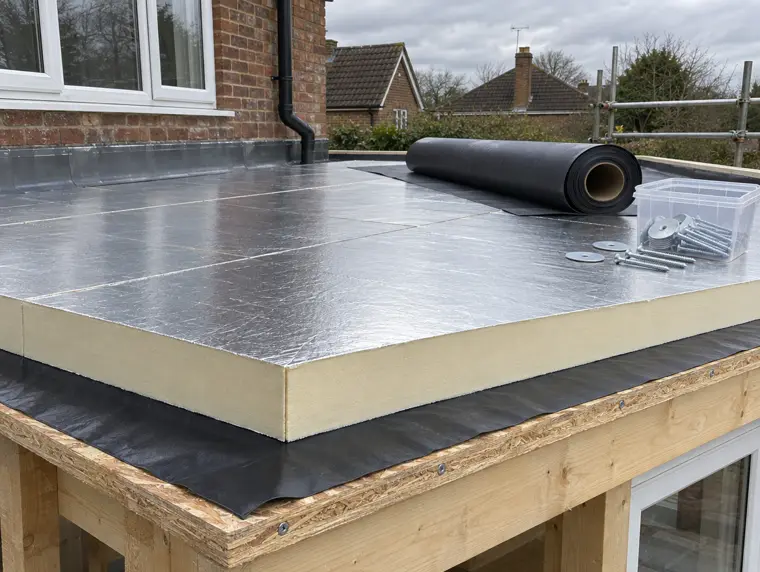
Many flat-roofed extensions and dormers in Carryduff were built with little or no insulation, or with a cold roof that was never properly ventilated. Those rooms are often hard to heat in winter and can suffer condensation, mould and, in time, a rotten deck.
Around Carryduff, flat roofs are common on bungalows with flat-roofed side extensions and dormers and on 1930s semis with flat-roofed garages and kitchen extensions. Northern Ireland averages roughly 1,150 mm of rain a year, spread over many wet days, so a roof that sheds water quickly to clear outlets lasts far longer than one that holds puddles.
How much does a warm roof upgrade cost in Carryduff?
At Northern Ireland guide rates, a 20 m² extension roof in EPDM with a new deck and insulation comes to £2,450–£4,300 including VAT. The fixed price comes after a free survey for new and replacement roofs.
| Job | Guide price inc VAT |
|---|---|
| Extension (20 m²), EPDM, new deck + insulation | £2,450–£4,300 |
| Extension (20 m²), EPDM with sedum green roof | £3,900–£7,100 |
Will insulating the roof raise its height, and what about doors and upstands?
Yes. A warm roof makes the roof thicker, often by more than 100 mm depending on the insulation and the U-value target. That extra height is the main thing we plan around.
Waterproofing at a wall usually needs to rise about 150 mm above the finished roof surface, so if the roof gets higher, the upstand has to go higher too. That can be a problem where the roof meets a door threshold, a low window sill, a cavity tray or a rooflight kerb. At the edges, trims and fascias are reset to the new level, and gutters may need to move.
Where there isn't enough height, the options include using thinner, higher-performance insulation, lowering the deck where the structure allows, raising the sill or threshold, or, where it is genuinely not feasible to reach the full target, insulating as far as is reasonable and recording why with building control. We work this out at the survey so there are no surprises on the day.
What's included?
- Upstands, trims and kerbs reset to the new roof level
- Survey of the deck, joists and existing insulation
- Building control or building standards handled where needed
- Rigid insulation boards sized to the U-value target
Building control in Northern Ireland
In Northern Ireland, Technical Booklet F1 sets roof insulation at 0.18 W/m²K when a roof over a heated room is renovated or newly built, where that's feasible. The district council's building control should be contacted before work starts, and we prepare the details it asks for. More on the rules.
Which nearby areas do we also cover?
Warm roof insulation upgrades in Carryduff: questions
Do you cover Carryduff?
Yes. Carryduff is part of our County Down coverage, including postcode districts BT8. Surveys and roofs are carried out by vetted roofing teams working under S&K Property Investments and Improvement Ltd.
Who checks building regulations for a flat roof in Carryduff?
Where the work needs approval it goes to Lisburn and Castlereagh City Council building control. We tell you at the survey whether your job needs it and deal with the paperwork as part of the quote.
How much does a warm roof upgrade cost in Carryduff?
£2,450–£4,300 for a 20 m² extension roof in EPDM with a new deck and insulation, at Northern Ireland guide rates including VAT. The fixed price comes after a free survey for new and replacement roofs.
Does a warm roof stop condensation?
It greatly reduces the risk by keeping the deck warm and placing a vapour control layer on the warm side. Good ventilation in kitchens and bathrooms below still helps.
Can you insulate a flat roof from inside instead?
It is possible, but insulating between or under the joists creates a cold roof, which needs ventilation and carries a higher condensation risk. When the roof is being re-covered anyway, a warm roof from above is usually the better option.