Stenhousemuir at a glance
- Postcode districts
- FK5
- Population
- about 9,620 (GeoNames)
- Council area
- Falkirk Council
- Building approval
- Falkirk Council building standards
- Nearest main town
- Falkirk, about 2 miles
- Guide price region
- Scotland (−5% on West Midlands rates)
Why upgrade to a warm roof in Stenhousemuir?
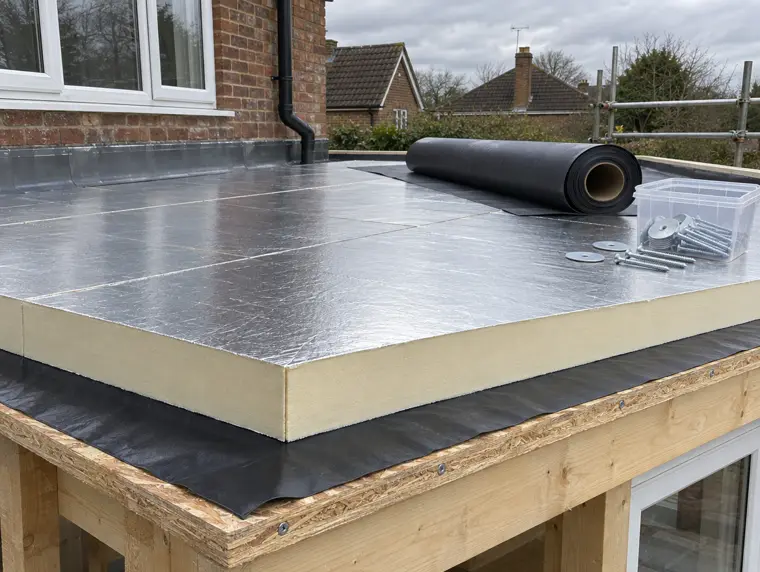
Small commercial buildings in Stenhousemuir with large flat roofs can lose a lot of heat through them. Where the roof is being replaced, upgrading the insulation at the same time is required in most cases and helps reduce running costs for the occupier.
In and around Stenhousemuir, flat roofs are typically found on 1930s semis with flat-roofed garages and kitchen extensions, and on newer estates where the first extension roofs are now being replaced. Scotland averages roughly 1,570 mm of rain a year, with the west far wetter than the east, so drainage, falls and wind uplift are part of every specification we write.
How much does a warm roof upgrade cost in Stenhousemuir?
For Stenhousemuir we use Scotland rates: £2,650–£4,650 is the guide for a 20 m² extension roof in EPDM with a new deck and insulation, VAT included. The fixed price comes after a free survey for new and replacement roofs.
| Job | Guide price inc VAT |
|---|---|
| Extension (20 m²), EPDM, new deck + insulation | £2,650–£4,650 |
| Extension (20 m²), EPDM with sedum green roof | £4,200–£7,700 |
How long does a warm roof last?
The insulation in a warm roof should last for the life of the waterproofing above it, as long as it stays dry. Rigid PIR boards don't settle or slump in the way some loose insulation can.
The waterproofing is what sets the timescale. EPDM is typically quoted at 25 to 50 years, GRP at 20 to 40 years and modern torch-on felt at 15 to 25 years with good specification and care. A warm build-up also helps the deck, because keeping it warm and dry lowers the risk of condensation rot. If the waterproofing fails and water gets into the insulation, the wet boards should be replaced, so leaks need prompt attention. The lifespan guide compares the systems.
What's included?
- Vapour control layer on the warm side of the insulation
- Rigid insulation boards sized to the U-value target
- Survey of the deck, joists and existing insulation
- Building standards handled where needed
Building standards in Scotland
In Scotland the building standards technical handbooks (Section 6 for energy) apply, and the council's building standards service decides whether a building warrant is needed. Like-for-like repairs to a roof covering can be exempt; alterations, structural work and new roofs usually need a warrant before work starts. The domestic roof benchmark is 0.12 W/m²K, applied as far as reasonably practicable on an existing roof. More on the rules.
Which nearby areas do we also cover?
Warm roof insulation upgrades in Stenhousemuir: questions
Do you cover Stenhousemuir?
Yes. Stenhousemuir is part of our Falkirk coverage, including postcode districts FK5. Surveys and roofs are carried out by vetted roofing teams working under S&K Property Investments and Improvement Ltd.
Who checks building standards for a flat roof in Stenhousemuir?
Where the work needs approval it goes to Falkirk Council building standards. We tell you at the survey whether your job needs it and deal with the paperwork as part of the quote.
How much does a warm roof upgrade cost in Stenhousemuir?
£2,650–£4,650 for a 20 m² extension roof in EPDM with a new deck and insulation, at Scotland guide rates including VAT. The fixed price comes after a free survey for new and replacement roofs.
How thick does flat roof insulation need to be?
It depends on the insulation product and the U-value target. With common PIR boards, meeting a renovation target usually means well over 100 mm. Thinner, higher-performance boards are available where height is tight.
Will a warm roof make my room warmer?
Usually, yes. A room under a poorly insulated flat roof loses less heat once the roof is upgraded and tends to feel more even in temperature. How much difference you notice depends on how the roof was built before.