- Guide price
- £13,900–£22,850
- Survey
- Free for new and replacement roofs
- Quote
- Fixed, in writing
- Coverage
- England, Wales, Scotland, NI
Cambridgeshire at a glance
- Largest towns
- Peterborough, Cambridge, Wisbech, St Neots
- Postcode areas
- CB, PE
- Building control
- Peterborough City Council, Cambridge City Council, Fenland District Council and 2 other councils
- Neighbouring areas
- Northamptonshire · Bedfordshire · Hertfordshire · Suffolk
- Guide price region
- East of England (+5% on West Midlands rates)
How much does a commercial flat roof cost in Cambridgeshire?
Guide prices including VAT at East of England rates. The fixed price comes after a free survey for new and replacement roofs.
| Job | Guide price inc VAT |
|---|---|
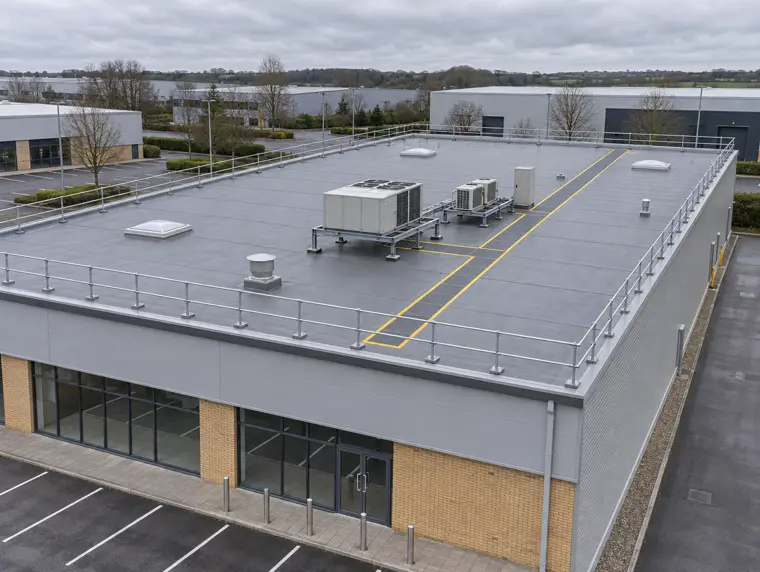
| Commercial roof (100 m²), single-ply + insulation | £13,900–£22,850 |
| Condition survey and leak investigation | £160–£320 |
| Block of flats (150 m²), felt + insulation + scaffold | £16,350–£28,550 |
Which flat roofs are common in Cambridgeshire?
Flat roofs in Cambridgeshire sit on terraced streets with flat-roofed rear kitchens and bathrooms, lock-up garage blocks on estates and low-rise post-war blocks of flats. The East of England is the driest part of Britain, with parts of the Anglian region around 630 mm a year, so summer heat and UV, not rainfall, do most of the ageing on a felt roof. Approximate 1991–2020 regional averages based on Met Office data.
Building regulations in England
Replacing more than half of a roof over a heated room usually counts as renovating a thermal element, so it is insulated to current standards and notified to building control. Renovated roofs over heated rooms are insulated to around 0.16 W/m²K where that's feasible, and new extension roofs are built to 0.15 W/m²K. In Cambridgeshire the application goes to Peterborough City Council, Cambridge City Council, Fenland District Council and 2 other councils. More on the rules.
Can you work around our trading hours and site rules?
Yes. Most commercial roofs can be replaced while the building stays open, and we agree the programme with you before any work starts.
That normally means set working hours, delivery and skip positions that keep entrances and fire exits clear, and phasing the roof so each section is watertight before the team leaves site. Noisy tasks such as strip-out can be timed for quieter periods, and early starts or weekend working can be arranged where your site allows. We tell you in advance which areas below the roof may be affected, so stock and equipment can be protected or moved.
Where torch-on felt is specified, the team works under your hot works permit system, with a fire watch after the torch is put away. If your site does not allow naked flames, we specify a cold-applied, self-adhesive or other flame-free system instead. Tenants, alarm companies and mechanical contractors are coordinated through one named contact.
How do you handle CDM, roof access and fragile surfaces?
Every job is planned under the Construction (Design and Management) Regulations 2015, or CDM (NI) 2016 in Northern Ireland, with a construction phase plan and a method statement for the roof.
As a commercial client you have duties under CDM too, including passing on information about the building, such as drawings, details of previous roof work and the asbestos register. Buildings put up before 2000 can contain asbestos, so we ask for the register or a refurbishment survey before pricing a strip-out. If asbestos is found, a licensed specialist surveys and removes it before we start.
Roofs and rooflights are treated as fragile until a competent person confirms otherwise. Edge protection goes up on every job, rooflights and fragile sheets are covered or fenced off, and we agree safe access before work starts: scaffold, a tower, a powered access platform or a fixed access point where one is suitable.
Which towns in Cambridgeshire do we cover?
Commercial flat roofing in Cambridgeshire: questions
Which towns in Cambridgeshire do you cover?
All of Cambridgeshire. The main towns have their own pages below, and if yours isn't listed we still cover it: send your postcode and we'll confirm.
How much does a commercial flat roof cost in Cambridgeshire?
£13,900–£22,850 for a 100 m² commercial roof in single-ply with insulation, at East of England guide rates including VAT. The fixed price comes after a free survey for new and replacement roofs.
Which council handles building control for a flat roof in Cambridgeshire?
It depends on where the roof is: in Cambridgeshire that's Peterborough City Council, Cambridge City Council, Fenland District Council and 2 other councils. Replacing more than half of a roof over a heated room usually counts as renovating a thermal element, so it is insulated to current standards and notified to building control. We confirm which applies at the survey.
Do you need a hot works permit?
Only if torch-on felt or other naked-flame work is used, in which case the team works under your permit system with a fire watch afterwards. Where hot works are not allowed, we specify a flame-free system such as a cold-applied membrane.
Can you re-roof while our premises stay open?
Usually, yes. We phase the work so each section is watertight before the team leaves site, keep entrances and fire exits clear, and agree working hours and deliveries with you first.
Who deals with building control on a commercial re-roof?
We do, where the work needs approval. Replacing more than half of a roof over heated space usually means upgrading the insulation towards the renovation U-value where feasible, which is 0.18 W/m²K for non-domestic buildings in England.
Everything about commercial flat roofing → · All flat roofing in Cambridgeshire →