Southwark at a glance
- Postcode districts
- SE5, SE15, SE17, SE22, SE14, SE11, SE1, SE8
- Council area
- London Borough of Southwark
- Building approval
- London Borough of Southwark building control, or a registered building control approver
- Guide price region
- London (+20% on West Midlands rates)
What do commercial flat roofs in Southwark need?
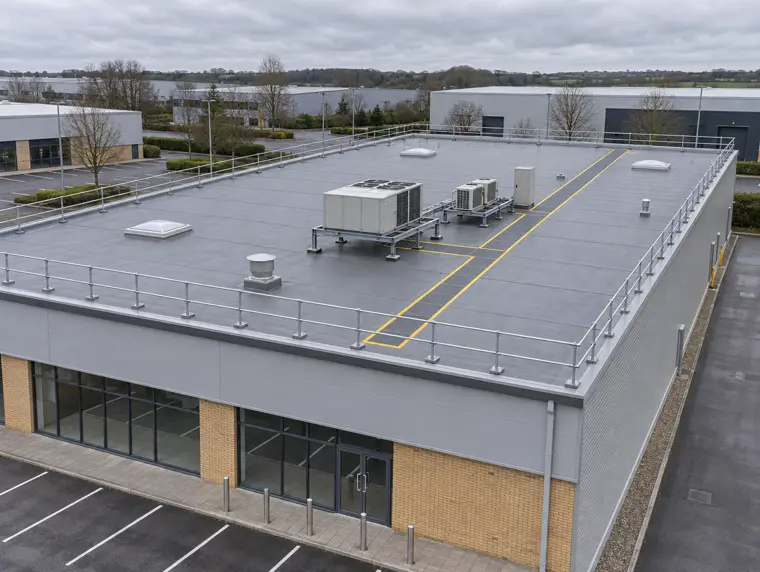
A commercial re-roof in Southwark has to fit around customers, staff and deliveries. We agree working hours, skip positions and access routes before we start, keep fire exits clear throughout, and choose a flame-free system where your site does not allow hot works near stock or occupied rooms.
In and around Southwark, flat roofs are typically found on shops with flat-roofed stores below flats above, and on mansion blocks and purpose-built flats with large flat roofs. The Thames basin is one of the drier parts of Britain at roughly 730 mm of rain a year, but summer heat is the bigger test here: dark membranes on south-facing roofs swing a long way in temperature.
How much does a commercial flat roof cost in Southwark?
For Southwark we use London rates: £15,900–£26,150 is the guide for a 100 m² commercial roof in single-ply with insulation, VAT included. The fixed price comes after a free survey for new and replacement roofs.
| Job | Guide price inc VAT |
|---|---|
| Commercial roof (100 m²), single-ply + insulation | £15,900–£26,150 |
| Condition survey and leak investigation | £180–£360 |
| Block of flats (150 m²), felt + insulation + scaffold | £18,650–£32,650 |
Which roofing system suits a commercial flat roof?
Single-ply membrane usually suits large, simple roofs; built-up felt suits roofs with heavy foot traffic, plant or complex detailing; and a liquid-applied overlay suits a sound roof that needs new waterproofing without a full strip-out.
- Single-ply (PVC, TPO or FPO): light and quick to lay over large areas, with hot-air welded laps and fixing or bonding designed for the site's wind uplift. Indicative life 25–35+ years. See single-ply roofing.
- Built-up felt: two or three layers of reinforced bitumen membrane laid to BS 8217, hard-wearing around plant and maintenance routes. Modern systems last 15–25 years, high-performance systems longer. See torch-on felt roofing.
- Liquid-applied overlay: a reinforced coating that cures to one continuous layer, well suited to pipework, plant bases and awkward details. Indicative life 10–25+ years depending on the product. See liquid roofing.
Mastic asphalt suits concrete decks and walkways, and EPDM suits simpler roofs with few penetrations. An overlay only works where the existing roof is dry and firmly bonded, so we check for wet insulation before recommending one (see overlay or strip).
What's included?
- CDM planning, edge protection and fragile-surface controls on every job
- Warm-roof insulation upgrades and building control where needed
- Written workmanship guarantee, with manufacturer guarantees registered where the system allows
- Single-ply, built-up felt, liquid-applied and mastic asphalt systems
Building regulations in England
Replacing more than half of a flat roof over a heated room usually counts as renovating a thermal element, so the roof is insulated to around 0.16 W/m²K where that's technically and economically feasible, and the work is notified to building control: the council or a registered building control approver, unless a registered competent person self-certifies it. A roof on a new extension is built to 0.15 W/m²K. Patch repairs, and most unheated detached garages, don't trigger the upgrade. Structural changes, or a new covering that adds 15% or more to the roof's weight, also need approval. More on the rules.
Which nearby areas do we also cover?
Commercial flat roofing in Southwark: questions
Do you cover Southwark?
Yes. Southwark is part of our London coverage, including postcode districts SE5, SE15, SE17, SE22, SE14, SE11 and 2 more. Surveys and roofs are carried out by vetted roofing teams working under S&K Property Investments and Improvement Ltd.
Who checks building regulations for a flat roof in Southwark?
Where the work needs approval it goes to London Borough of Southwark building control, or a registered building control approver. We tell you at the survey whether your job needs it and deal with the paperwork as part of the quote.
How much does a commercial flat roof cost in Southwark?
£15,900–£26,150 for a 100 m² commercial roof in single-ply with insulation, at London guide rates including VAT. The fixed price comes after a free survey for new and replacement roofs.
Can the cost be spread over more than one budget year?
Yes. We can price a phased programme with each section shown separately, starting with the most urgent areas, so you can plan the spend while the building stays protected.
Do you need a hot works permit?
Only if torch-on felt or other naked-flame work is used, in which case the team works under your permit system with a fire watch afterwards. Where hot works are not allowed, we specify a flame-free system such as a cold-applied membrane.