March at a glance
- Postcode districts
- PE15
- Population
- about 21,051 (GeoNames)
- Council area
- Fenland District Council
- Building approval
- Fenland District Council building control, or a registered building control approver
- Nearest main town
- Peterborough, about 14 miles
- Guide price region
- East of England (+5% on West Midlands rates)
Why choose EPDM rubber roofing in March?
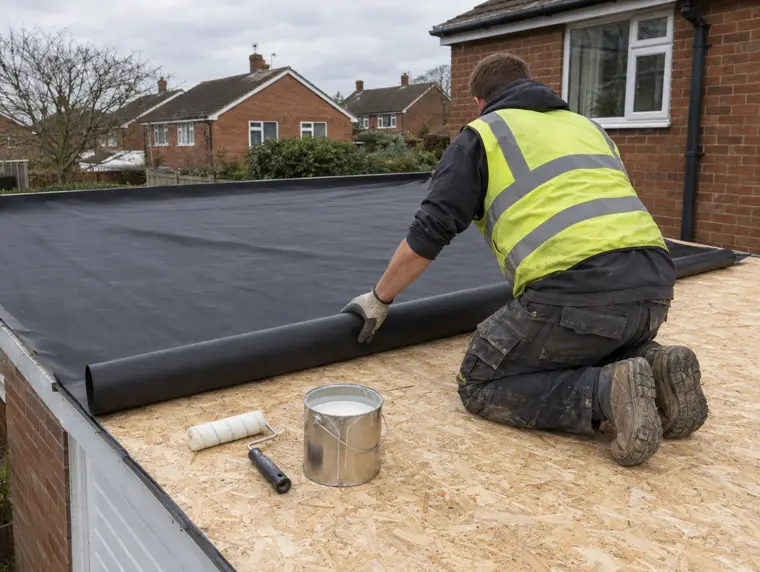
Choose EPDM in March if you want a long service life without paying for a hard, walkable finish you do not need. With good detailing it typically lasts 25 years or more, and manufacturer material guarantees are available on many EPDM systems, registered for you where the system allows.
March's flat roofs are mostly on low-rise post-war blocks of flats, with plenty on bungalows with flat-roofed side extensions and dormers too. The East of England is the driest part of Britain, with parts of the Anglian region around 630 mm a year, so summer heat and UV, not rainfall, do most of the ageing on a felt roof.
How much does an EPDM rubber roof cost in March?
For March we use East of England rates: £1,700–£2,950 is the guide for a typical 18 m² garage roof in EPDM, VAT included. The fixed price comes after a free survey for new and replacement roofs.
| Job | Guide price inc VAT |
|---|---|
| Single garage (18 m²), EPDM rubber | £1,700–£2,950 |
| Extension (20 m²), EPDM, new deck + insulation | £2,950–£5,150 |
| Porch or bay (4 m²), EPDM | £800–£1,300 |
When is EPDM the right choice, and when is another system better?
EPDM is a strong choice for simple domestic roofs that people do not walk on, such as garages, single-storey extensions, porches and dormers. It is less suited to roofs with regular foot traffic or many pipes and vents.
Where it does well: few or no joins on small roofs, flexible in cold weather, tolerant of minor building movement, and laid without a flame.
Where it falls short: the finish is plain dark rubber, it can be punctured by dropped tools or sharp debris, and it is not designed as a walking surface without added protection. Roofs with many penetrations take a lot of careful detailing.
If you want a hard, walkable finish or a complex shape, GRP fibreglass often suits better. On a tight budget, or a larger roof where a layered system is preferred, torch-on felt is worth pricing. Liquid-applied roofing handles awkward details and overlays, single-ply membranes are built for larger commercial roofs, and mastic asphalt belongs on older and heritage buildings. Our EPDM vs GRP vs felt guide sets them side by side.
What's included?
- Warm-roof insulation and vapour control layer where required
- Deck check and replacement of soft or rotten boards
- New drip and kerb trims, outlets and upstand details
- Strip-out of the old covering, with waste taken away
Building regulations in England
Replacing more than half of a flat roof over a heated room usually counts as renovating a thermal element, so the roof is insulated to around 0.16 W/m²K where that's technically and economically feasible, and the work is notified to building control: the council or a registered building control approver, unless a registered competent person self-certifies it. A roof on a new extension is built to 0.15 W/m²K. Patch repairs, and most unheated detached garages, don't trigger the upgrade. Structural changes, or a new covering that adds 15% or more to the roof's weight, also need approval. More on the rules.
Which nearby areas do we also cover?
EPDM rubber roofing in March: questions
Do you cover March?
Yes. March is part of our Cambridgeshire coverage, including postcode districts PE15. Surveys and roofs are carried out by vetted roofing teams working under S&K Property Investments and Improvement Ltd.
Who checks building regulations for a flat roof in March?
Where the work needs approval it goes to Fenland District Council building control, or a registered building control approver. We tell you at the survey whether your job needs it and deal with the paperwork as part of the quote.
How much does an EPDM rubber roof cost in March?
£1,700–£2,950 for a typical 18 m² garage roof in EPDM, at East of England guide rates including VAT. The fixed price comes after a free survey for new and replacement roofs.
How long does it take to fit an EPDM roof?
A single garage typically takes one to two days and an insulated extension roof two to three, weather permitting. Larger roofs, scaffold and complex details add time.
Can a punctured EPDM roof be repaired?
Usually, yes. The area is cleaned and primed, then an EPDM patch or cover tape is bonded over the damage. If water has reached the deck, a survey first is sensible.