- Price per m²
- £67–£118
- Typical life
- 25–50 years
- Manufacturer guarantees
- 20-year material warranties are common
- Typical garage roof
- £1,650–£2,900
Gloucestershire at a glance
- Largest towns
- Gloucester, Cheltenham, Stroud, Kingswood
- Postcode areas
- BS, GL
- Building control
- Gloucester City Council, Cheltenham Borough Council, Stroud District Council and 3 other councils
- Neighbouring areas
- Bristol · Wiltshire · Herefordshire · Somerset
- Guide price region
- South West (+3% on West Midlands rates)
How much does an EPDM rubber roof cost in Gloucestershire?
Guide prices including VAT at South West rates. The fixed price comes after a free survey for new and replacement roofs.
| Job | Guide price inc VAT |
|---|---|
| Single garage (18 m²), EPDM rubber | £1,650–£2,900 |
| Extension (20 m²), EPDM, new deck + insulation | £2,900–£5,050 |
| Porch or bay (4 m²), EPDM | £750–£1,300 |
Which flat roofs are common in Gloucestershire?
Flat roofs in Gloucestershire sit on terraced streets with flat-roofed rear kitchens and bathrooms, low-rise post-war blocks of flats and 1930s semis with flat-roofed garages and kitchen extensions. The South West averages roughly 1,260 mm of rain a year and many roofs face wind off the Atlantic, so we specify fixings and edge details for wind uplift as well as drainage. Approximate 1991–2020 regional averages based on Met Office data.
Building regulations in England
Replacing more than half of a roof over a heated room usually counts as renovating a thermal element, so it is insulated to current standards and notified to building control. Renovated roofs over heated rooms are insulated to around 0.16 W/m²K where that's feasible, and new extension roofs are built to 0.15 W/m²K. In Gloucestershire the application goes to Gloucester City Council, Cheltenham Borough Council, Stroud District Council and 3 other councils. More on the rules.
When is EPDM the right choice, and when is another system better?
EPDM is a strong choice for simple domestic roofs that people do not walk on, such as garages, single-storey extensions, porches and dormers. It is less suited to roofs with regular foot traffic or many pipes and vents.
Where it does well: few or no joins on small roofs, flexible in cold weather, tolerant of minor building movement, and laid without a flame.
Where it falls short: the finish is plain dark rubber, it can be punctured by dropped tools or sharp debris, and it is not designed as a walking surface without added protection. Roofs with many penetrations take a lot of careful detailing.
If you want a hard, walkable finish or a complex shape, GRP fibreglass often suits better. On a tight budget, or a larger roof where a layered system is preferred, torch-on felt is worth pricing. Liquid-applied roofing handles awkward details and overlays, single-ply membranes are built for larger commercial roofs, and mastic asphalt belongs on older and heritage buildings. Our EPDM vs GRP vs felt guide sets them side by side.
How are the joins, edges and upstands made watertight on an EPDM roof?
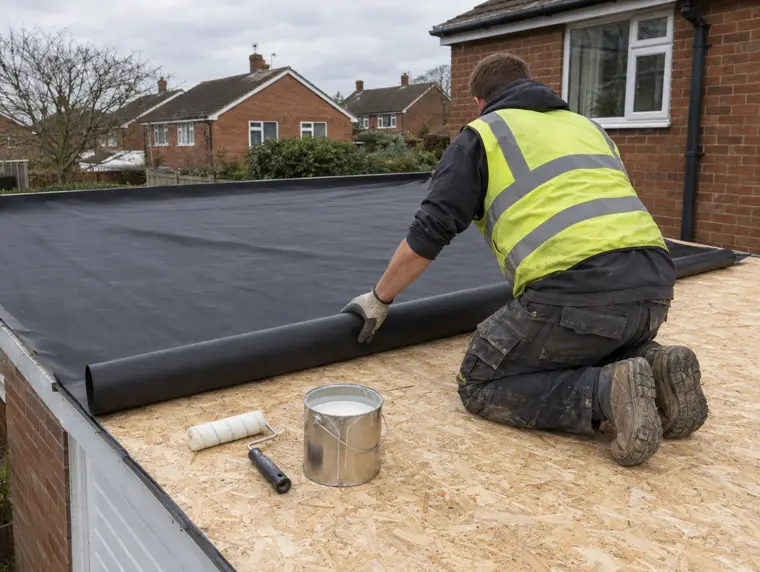
They are bonded with contact adhesive and sealed with purpose-made EPDM tapes and pre-formed pieces, because the edges and details are where most rubber roof leaks start.
- Wall upstands: the rubber is turned up the wall, usually to about 150 mm above the finished roof, fully bonded, then finished with a termination bar or a cover flashing chased into the masonry.
- Corners: folded rather than cut where possible, or finished with pre-formed pieces.
- Joins: on roofs wider than one sheet, the laps are cleaned, primed and joined with splice tape, then rolled firmly.
- Pipes and vents: sealed with pre-formed pipe boots rather than relying on mastic.
- Edges and outlets: drip and kerb trims are fixed and the junction with the membrane is sealed with cover tape; outlets are bonded into the membrane at the lowest point.
We also check the falls before laying, because standing water around an outlet shortens the life of any detail. There is more on this in our pages on edges and drainage and rooflight upstands.
Which towns in Gloucestershire do we cover?
EPDM rubber roofing in Gloucestershire: questions
Which towns in Gloucestershire do you cover?
All of Gloucestershire. The main towns have their own pages below, and if yours isn't listed we still cover it: send your postcode and we'll confirm.
How much does an EPDM rubber roof cost in Gloucestershire?
£1,650–£2,900 for a typical 18 m² garage roof in EPDM, at South West guide rates including VAT. The fixed price comes after a free survey for new and replacement roofs.
Which postcode areas do you cover in Gloucestershire?
All of Gloucestershire, including the BS, GL postcode areas. Send your full postcode and we'll confirm.
Can a punctured EPDM roof be repaired?
Usually, yes. The area is cleaned and primed, then an EPDM patch or cover tape is bonded over the damage. If water has reached the deck, a survey first is sensible.
Can EPDM be laid over an old felt roof?
Sometimes, but we usually recommend stripping old felt first. Overlaying hides any rot or wet insulation underneath, and over a heated room a full replacement is often when insulation has to be added anyway.
How long does it take to fit an EPDM roof?
A single garage typically takes one to two days and an insulated extension roof two to three, weather permitting. Larger roofs, scaffold and complex details add time.
Everything about EPDM rubber roofing → · All flat roofing in Gloucestershire →