Skegness at a glance
- Postcode districts
- PE25
- Population
- about 24,876 (GeoNames)
- Council area
- East Lindsey District Council
- Building approval
- East Lindsey District Council building control, or a registered building control approver
- Guide price region
- East Midlands (−2% on West Midlands rates)
When is a flat roof survey worth it in Skegness?
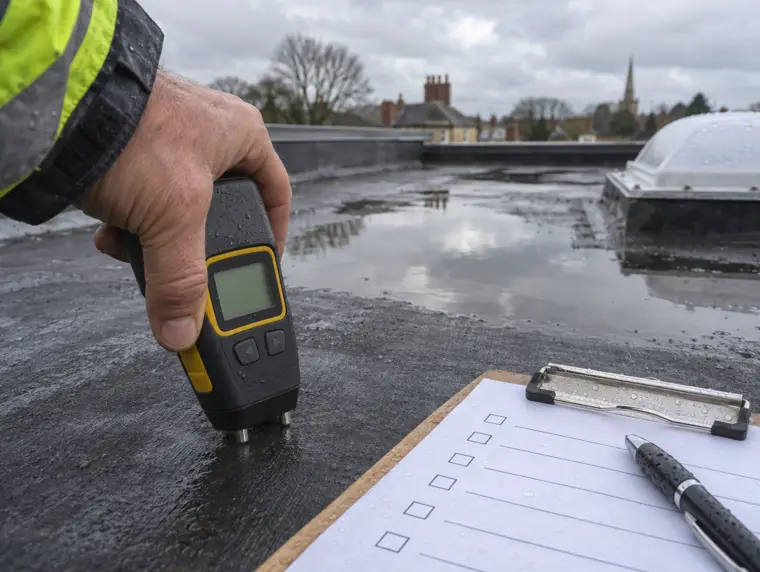
Businesses in Skegness with a flat-roofed building can't plan maintenance around guesswork. A survey sets out what needs doing now, what can wait and roughly what each item will cost, so the work can be scheduled with as little disruption as possible.
In a town like Skegness, flat roofs are commonly found on 1930s semis with flat-roofed garages and kitchen extensions or terraced streets with flat-roofed rear kitchens and bathrooms. The East Midlands is drier than the west of Britain, so most flat roofs here fail through age, UV and poor detailing at upstands rather than sheer rainfall.
How much does a flat roof survey cost in Skegness?
For Skegness we use East Midlands rates: £150–£290 is the guide for a condition survey and leak investigation, VAT included. We confirm the price once we've traced the leak or seen the damage.
| Job | Guide price inc VAT |
|---|---|
| Condition survey and leak investigation | £150–£290 |
| Localised patch repair | £150–£490 |
| Upstand or flashing repair | £250–£640 |
| Emergency temporary weatherproofing visit | £180–£440 |
How long does a flat roof survey take and how long is it valid?
A survey of a typical garage or extension roof usually takes an hour or two on site. Larger, higher or multi-area roofs take longer, and the written report follows afterwards.
A survey describes the roof on the day it was inspected. It stays a useful baseline for planning, but roofs change, particularly older ones and after a hard winter or a storm. If you are using a report to plan a replacement some time later, or after a fresh leak, a short follow-up check is sensible. For roofs you manage over the long term, a regular inspection backed by the maintenance checklist picks up problems early.
What's included?
- Free quote if replacement is the right answer
- Core samples where readings need confirming
- Plain written report with ranked recommendations
- Inspection of the covering, upstands, edges and outlets
Building regulations in England
Replacing more than half of a flat roof over a heated room usually counts as renovating a thermal element, so the roof is insulated to around 0.16 W/m²K where that's technically and economically feasible, and the work is notified to building control: the council or a registered building control approver, unless a registered competent person self-certifies it. A roof on a new extension is built to 0.15 W/m²K. Patch repairs, and most unheated detached garages, don't trigger the upgrade. Structural changes, or a new covering that adds 15% or more to the roof's weight, also need approval. More on the rules.
Which nearby areas do we also cover?
Flat roof surveys and leak tracing in Skegness: questions
Do you cover Skegness?
Yes. Skegness is part of our Lincolnshire coverage, including postcode districts PE25. Surveys and roofs are carried out by vetted roofing teams working under S&K Property Investments and Improvement Ltd.
Who checks building regulations for a flat roof in Skegness?
Where the work needs approval it goes to East Lindsey District Council building control, or a registered building control approver. We tell you at the survey whether your job needs it and deal with the paperwork as part of the quote.
How much does a flat roof survey cost in Skegness?
£150–£290 for a condition survey and leak investigation, at East Midlands guide rates including VAT. We confirm the price once we've traced the leak or seen the damage.
Is a core sample damaging to the roof?
It's a small, deliberate opening that is sealed again with compatible material before we leave. It shouldn't affect how the roof performs.
Can you trace a flat roof leak without opening the roof up?
Often, yes. Careful inspection and moisture readings can usually locate the problem area. Where they can't, a small core sample is the most reliable way to confirm what is happening under the covering.