- Guide price
- £16,350–£28,550
- Survey
- Free for new and replacement roofs
- Quote
- Fixed, in writing
- Coverage
- England, Wales, Scotland, NI
Essex at a glance
- Largest towns
- Southend-on-Sea, Basildon, Colchester, Chelmsford
- Postcode areas
- CB, CM, CO, EN, RM, SS
- Building control
- Southend-on-Sea City Council, Basildon Council, Colchester City Council and 11 other councils
- Neighbouring areas
- Kent · London · Hertfordshire · Suffolk
- Guide price region
- East of England (+5% on West Midlands rates)
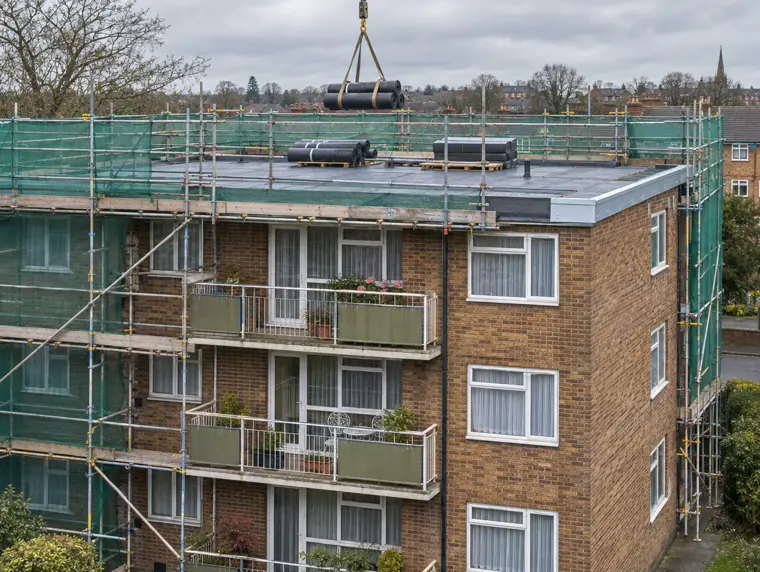
How much does a block or HMO roof cost in Essex?
Guide prices including VAT at East of England rates. The fixed price comes after a free survey for new and replacement roofs.
| Job | Guide price inc VAT |
|---|---|
| Block of flats (150 m²), felt + insulation + scaffold | £16,350–£28,550 |
| Commercial roof (100 m²), single-ply + insulation | £13,900–£22,850 |
Which flat roofs are common in Essex?
Flat roofs in Essex sit on bungalows with flat-roofed side extensions and dormers, 1960s and 1970s link-detached houses with flat-roofed garages and porches and terraced streets with flat-roofed rear kitchens and bathrooms. The East of England is the driest part of Britain, with parts of the Anglian region around 630 mm a year, so summer heat and UV, not rainfall, do most of the ageing on a felt roof. Approximate 1991–2020 regional averages based on Met Office data.
Building regulations in England
Replacing more than half of a roof over a heated room usually counts as renovating a thermal element, so it is insulated to current standards and notified to building control. Renovated roofs over heated rooms are insulated to around 0.16 W/m²K where that's feasible, and new extension roofs are built to 0.15 W/m²K. In Essex the application goes to Southend-on-Sea City Council, Basildon Council, Colchester City Council and 11 other councils. More on the rules.
Which roofing systems last longest on a block of flats?
Mastic asphalt, EPDM, single-ply and high-performance built-up felt all give long service lives on block roofs; the right choice depends on the deck, how the roof is used, the details and the whole-life cost.
- Mastic asphalt: 30–60 years with maintenance, common on concrete-decked blocks and walkways. See mastic asphalt roofing.
- EPDM: 25–50 years, laid in large sheets with few joins.
- Single-ply: 25–35+ years, quick to lay on larger roofs, with welded laps. See single-ply roofing.
- Built-up felt: 15–25 years for modern torch-on systems and longer for high-performance systems, robust where maintenance teams walk the roof.
- Liquid-applied: 10–25+ years by product, useful as an overlay on a sound roof with complex details.
The cheapest roof today is not always the cheapest over the life of the building. A longer-life system, with tapered insulation to cure ponding, can mean fewer reactive repairs and fewer rounds of consultation. These lives are indicative and assume good specification and regular maintenance.
Do fire and insulation rules affect block roofs?
Yes. Where a roof is close to a boundary, building regulations limit which coverings can be used, and the build-up should carry a suitable external fire classification such as BROOF(t4); in England this is covered by Approved Document B.
BROOF(t4) applies to a tested build-up, so we check that the manufacturer's classification covers the deck, insulation and membrane actually being installed, not just the membrane name. Where the roof crosses a separating or compartment wall, the fire-stopping detail is kept intact.
Re-covering more than half of a roof over heated flats usually triggers the thermal element rules, so the insulation is upgraded towards the renovation U-value where feasible: 0.16 W/m²K for dwellings in England and Wales. We handle building control where it is needed. See building regulations and warm vs cold roofs.
Which towns in Essex do we cover?
- Southend-on-Sea
- Basildon
- Colchester
- Chelmsford
- Harlow
- Grays
- Braintree
- Brentwood
- Clacton-on-Sea
- South Benfleet
- Canvey Island
- Billericay
- Rayleigh
- Stanford-le-Hope
- Wickford
- Witham
- Pitsea
- Maldon
- Waltham Abbey
- South Ockendon
- Harwich
- Hadleigh
- Walton-on-the-Naze
- Frinton-on-Sea
- Rochford
- Saffron Walden
Flats, HMOs and block roofs in Essex: questions
Which towns in Essex do you cover?
All of Essex. The main towns have their own pages below, and if yours isn't listed we still cover it: send your postcode and we'll confirm.
How much does a block or HMO roof cost in Essex?
£16,350–£28,550 for a 150 m² block-of-flats roof in felt with insulation and scaffold, at East of England guide rates including VAT. The fixed price comes after a free survey for new and replacement roofs.
Which postcode areas do you cover in Essex?
All of Essex, including the CB, CM, CO, EN, RM, SS postcode areas. Send your full postcode and we'll confirm.
Can a block roof be replaced in phases?
Yes. Larger roofs can be split into sections over one or more budget years, with each phase priced separately and each section left watertight before the team leaves site.
Do residents need to move out during a re-roof?
No. Block roofs are normally replaced with residents in place, and if we need to check a ceiling inside a top-floor flat, access is arranged through the agent or landlord.
Do you run the Section 20 consultation?
No. The freeholder or managing agent runs the consultation; we provide itemised written quotes that can be shared with leaseholders and answer technical questions passed on through the agent.
Everything about flats, HMOs and block roofs → · All flat roofing in Essex →