Coleraine at a glance
- Postcode districts
- BT51, BT52, BT55, BT56
- Population
- about 25,681 (GeoNames)
- Council area
- Causeway Coast and Glens Borough Council
- Building approval
- Causeway Coast and Glens Borough Council building control
- Guide price region
- Northern Ireland (−12% on West Midlands rates)
Why choose a green roof in Coleraine?
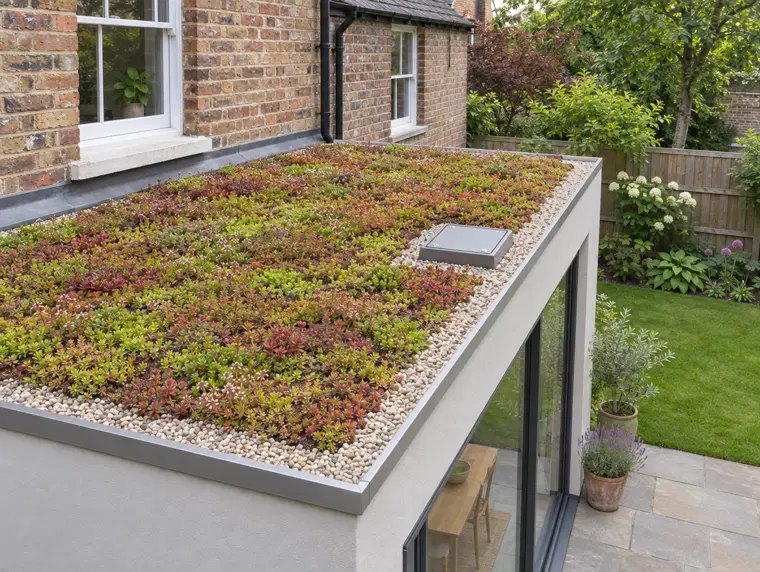
Homeowners in Coleraine building a new extension may find a green roof can help with a planning application, as some councils encourage them for biodiversity and slower rainwater run-off. It is worth raising early with your designer, before the roof structure is drawn up, so the joists can be sized for the extra weight.
In and around Coleraine, flat roofs are typically found on bungalows with flat-roofed side extensions and dormers, and on 1930s semis with flat-roofed garages and kitchen extensions. Northern Ireland averages roughly 1,150 mm of rain a year, spread over many wet days, so a roof that sheds water quickly to clear outlets lasts far longer than one that holds puddles.
How much does a green roof cost in Coleraine?
At Northern Ireland guide rates, a 20 m² insulated extension roof finished as a sedum green roof comes to £3,900–£7,100 including VAT. The fixed price comes after a free survey for new and replacement roofs.
| Job | Guide price inc VAT |
|---|---|
| Extension (20 m²), EPDM with sedum green roof | £3,900–£7,100 |
| Extension (20 m²), EPDM, new deck + insulation | £2,450–£4,300 |
Can a green roof go on my existing flat roof?
Only if the existing waterproofing is sound, root-resistant or protected by a root barrier, and has plenty of life left. In most cases it makes more sense to lay a green roof as part of a replacement.
Once the sedum, substrate and drainage layers are down, the membrane underneath is hard to inspect and expensive to repair, because the green layers have to be lifted to get to it. Putting a green roof on an ageing covering risks paying for the greenery twice. Our repair or replace guide helps you judge whether your current roof is a sensible base.
As for planning, re-covering a house roof normally needs no application if its appearance doesn't change materially. Because a green roof does change how a roof looks, check with your council, especially for listed buildings, conservation areas and roofs that are easily seen. The planning guide has more.
What's included?
- Warm or inverted build-up to suit the roof
- Pre-grown sedum blankets laid and watered in
- Root-resistant membrane or separate root barrier
- Drainage layer, filter and lightweight growing medium
Building control in Northern Ireland
In Northern Ireland, Technical Booklet F1 sets roof insulation at 0.18 W/m²K when a roof over a heated room is renovated or newly built, where that's feasible. The district council's building control should be contacted before work starts, and we prepare the details it asks for. More on the rules.
Which nearby areas do we also cover?
Green and sedum roofs in Coleraine: questions
Do you cover Coleraine?
Yes. Coleraine is part of our County Londonderry coverage, including postcode districts BT51, BT52, BT55, BT56. Surveys and roofs are carried out by vetted roofing teams working under S&K Property Investments and Improvement Ltd.
Who checks building regulations for a flat roof in Coleraine?
Where the work needs approval it goes to Causeway Coast and Glens Borough Council building control. We tell you at the survey whether your job needs it and deal with the paperwork as part of the quote.
How much does a green roof cost in Coleraine?
£3,900–£7,100 for a 20 m² insulated extension roof finished as a sedum green roof, at Northern Ireland guide rates including VAT. The fixed price comes after a free survey for new and replacement roofs.
Can you put a green roof on a pitched roof?
We install green roofs on flat roofs only. Sloping green roofs need extra restraint to stop the growing medium slipping, and they are a specialist job outside our work.
Does a green roof leak more than a normal flat roof?
No, as long as it is built correctly. The waterproofing beneath is what keeps water out, and the green layers protect it from sun and weather. The main risk is building it on a weak or ageing membrane.