- Guide price
- £4,650–£8,500
- Survey
- Free for new and replacement roofs
- Quote
- Fixed, in writing
- Coverage
- England, Wales, Scotland, NI
Norfolk at a glance
- Largest towns
- Norwich, Great Yarmouth, King's Lynn, Thetford
- Postcode areas
- IP, NR, PE
- Building control
- Norwich City Council, Great Yarmouth Borough Council, Borough Council of King's Lynn and West Norfolk and 1 other council
- Neighbouring areas
- Suffolk · Cambridgeshire · Essex · Lincolnshire
- Guide price region
- East of England (+5% on West Midlands rates)
How much does a green roof cost in Norfolk?
Guide prices including VAT at East of England rates. The fixed price comes after a free survey for new and replacement roofs.
| Job | Guide price inc VAT |
|---|---|
| Extension (20 m²), EPDM with sedum green roof | £4,650–£8,500 |
| Extension (20 m²), EPDM, new deck + insulation | £2,950–£5,150 |
Which flat roofs are common in Norfolk?
Flat roofs in Norfolk sit on lock-up garage blocks on estates, bungalows with flat-roofed side extensions and dormers and 1960s and 1970s link-detached houses with flat-roofed garages and porches. The East of England is the driest part of Britain, with parts of the Anglian region around 630 mm a year, so summer heat and UV, not rainfall, do most of the ageing on a felt roof. Approximate 1991–2020 regional averages based on Met Office data.
Building regulations in England
Replacing more than half of a roof over a heated room usually counts as renovating a thermal element, so it is insulated to current standards and notified to building control. Renovated roofs over heated rooms are insulated to around 0.16 W/m²K where that's feasible, and new extension roofs are built to 0.15 W/m²K. In Norfolk the application goes to Norwich City Council, Great Yarmouth Borough Council, Borough Council of King's Lynn and West Norfolk and 1 other council. More on the rules.
How is a green roof built on top of a flat roof?
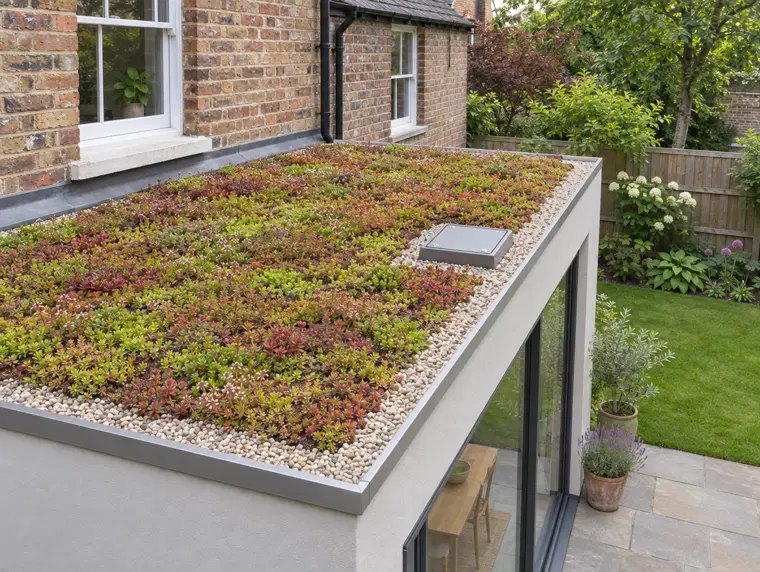
From the bottom up, a green roof is a deck, a waterproofing system with root protection, then drainage, filter, growing medium and plants. The waterproofing does the job of keeping water out. The green layers sit above it.
- Warm roof build-up: vapour control layer, insulation and waterproof membrane on the deck, then the green layers on top. This is the usual choice on a home extension being re-roofed.
- Inverted build-up: waterproofing on the deck, then insulation boards designed to sit above it, then the green layers. This is common on terraces and some commercial roofs.
- Root barrier: roots will exploit any weakness, so the membrane needs to be root-resistant. Some membranes are tested as root-resistant; others need a separate root barrier laid on top.
- Drainage and edges: a drainage layer carries surplus water to outlets, and a gravel or pebble strip is usually left around edges, outlets, upstands and rooflights to keep them clear and accessible.
Upstands still need to rise around 150 mm above the finished surface, which on a green roof means above the top of the growing medium. We check that at the survey, alongside the external fire performance of the build-up where the roof is close to a boundary.
Can my flat roof take the weight of a green roof?
Not every roof can, which is why we check the structure before quoting. A sedum roof is light compared with an intensive garden, but its growing medium holds water, and a saturated build-up adds significant weight to the roof.
We look at the joist sizes, spans and spacing, the condition of the deck and what the roof sits on. On a recently built extension with generously sized joists, an extensive green roof may be straightforward. On an older garage or a roof with undersized or rotten timbers, the structure may need strengthening, or a structural engineer's calculation may be needed before we can go ahead.
In England, a new roof covering that adds 15% or more to the weight of the roof triggers building control approval, and a green roof will often fall into that category. We handle building control where it is needed. The building regulations page covers the approval routes in each nation.
Which towns in Norfolk do we cover?
Green and sedum roofs in Norfolk: questions
Which towns in Norfolk do you cover?
All of Norfolk. The main towns have their own pages below, and if yours isn't listed we still cover it: send your postcode and we'll confirm.
How much does a green roof cost in Norfolk?
£4,650–£8,500 for a 20 m² insulated extension roof finished as a sedum green roof, at East of England guide rates including VAT. The fixed price comes after a free survey for new and replacement roofs.
Which council handles building control for a flat roof in Norfolk?
It depends on where the roof is: in Norfolk that's Norwich City Council, Great Yarmouth Borough Council, Borough Council of King's Lynn and West Norfolk and 1 other council. Replacing more than half of a roof over a heated room usually counts as renovating a thermal element, so it is insulated to current standards and notified to building control. We confirm which applies at the survey.
Can you put a green roof on a pitched roof?
We install green roofs on flat roofs only. Sloping green roofs need extra restraint to stop the growing medium slipping, and they are a specialist job outside our work.
What happens if a green roof needs repairing?
The green layers are lifted around the problem area, the membrane is repaired, and the layers are relaid. Building on a sound, long-life membrane in the first place keeps that to a minimum.
Does a green roof leak more than a normal flat roof?
No, as long as it is built correctly. The waterproofing beneath is what keeps water out, and the green layers protect it from sun and weather. The main risk is building it on a weak or ageing membrane.
Everything about green and sedum roofs → · All flat roofing in Norfolk →