- Guide price
- £110–£330
- Repair price
- Confirmed once the leak or damage is found
- Condition survey report
- £140–£290
- Coverage
- England, Wales, Scotland, NI
Angus at a glance
- Largest towns
- Arbroath, Forfar, Montrose, Carnoustie
- Postcode areas
- DD
- Building standards
- Angus Council
- Neighbouring areas
- Dundee City · Perth and Kinross · Fife · Aberdeen City
- Guide price region
- Scotland (−5% on West Midlands rates)
How much does a new roof edge or outlet cost in Angus?
Guide prices including VAT at Scotland rates. We confirm the price once we've traced the leak or seen the damage.
| Job | Guide price inc VAT |
|---|---|
| Outlet or drainage repair | £110–£330 |
| Localised patch repair | £140–£480 |
| Upstand or flashing repair | £240–£620 |
| Emergency temporary weatherproofing visit | £170–£430 |
| Condition survey and leak investigation | £140–£290 |
Which flat roofs are common in Angus?
Flat roofs in Angus sit on bungalows with flat-roofed side extensions and dormers, newer estates where the first extension roofs are now being replaced and 1930s semis with flat-roofed garages and kitchen extensions. Scotland averages roughly 1,570 mm of rain a year, with the west far wetter than the east, so drainage, falls and wind uplift are part of every specification we write. Approximate 1991–2020 regional averages based on Met Office data.
Building standards in Scotland
In Scotland a building warrant is usually needed for alterations, structural work and new roofs; like-for-like repairs to a covering can be exempt. Section 6 of the technical handbooks sets a domestic roof benchmark of 0.12 W/m²K, applied as far as reasonably practicable on an existing roof. In Angus the application goes to Angus Council (building standards). More on the rules.
Do flat roofs need overflows?
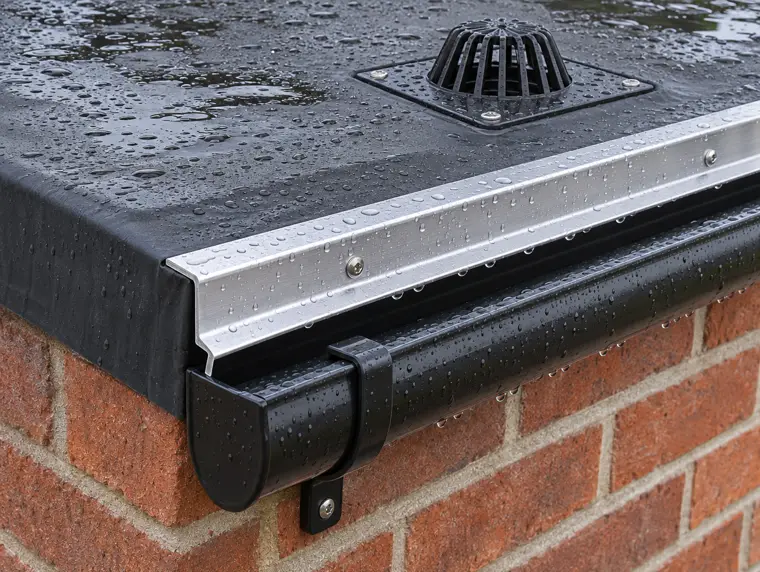
Roofs that drain to internal outlets or behind parapets should normally have an overflow, so that if an outlet blocks, water spills somewhere visible instead of rising over the upstands and into the building.
An overflow is usually a spout or weir set through the parapet or kerb at a level below the top of the upstands. When water runs from it, that is a sign the main outlet is blocked or overloaded. On a simple roof that drains over a drip trim into an external gutter, the open edge itself does the same job.
We look at where the water goes in heavy rain, how many outlets the roof has for its size, and whether the outlets, hoppers and downpipes are clear and properly connected. Leaf guards on outlets help on roofs near trees, as long as they are cleared regularly.
Why does water sit on my flat roof?
Water sits on a flat roof because it can't drain off fast enough: the falls are too shallow, part of the roof slopes the wrong way, the deck has sagged between joists, or an outlet is blocked or set too high.
Current guidance on flat roof design (BS 6229) means most roofs need to achieve a finished fall of at least 1:80, and roofs are commonly designed with a steeper fall, such as 1:60, so that building tolerances and deck deflection still leave enough slope. Many older roofs were built with less, or have settled over time.
A small amount of water that clears within a day or two of rain is often tolerable. Deeper ponding that lingers adds weight, holds dirt and debris, can shorten the life of some coverings and turns any small defect into a leak. A patch won't fix it, because the problem is the shape of the roof. The fix is to correct the falls, either with firring pieces under a new deck or with tapered insulation in a warm roof, or to add or lower outlets so water has somewhere to go. Our ponding water guide explains this in more detail.
Which towns in Angus do we cover?
Edge trims, outlets and drainage in Angus: questions
Which towns in Angus do you cover?
All of Angus. The main towns have their own pages below, and if yours isn't listed we still cover it: send your postcode and we'll confirm.
How much does a new roof edge or outlet cost in Angus?
£110–£330 for an outlet or drainage repair, at Scotland guide rates including VAT. We confirm the price once we've traced the leak or seen the damage.
Which council handles building standards for a flat roof in Angus?
It depends on where the roof is: in Angus that's Angus Council. In Scotland a building warrant is usually needed for alterations, structural work and new roofs; like-for-like repairs to a covering can be exempt. We confirm which applies at the survey.
Is some standing water on a flat roof normal?
A thin film that clears within a day or two of rain is common and usually harmless. Deeper water that lingers for days points to poor falls, a sagging deck or a blocked outlet and should be looked at.
Why is my fascia rotting under a flat roof?
Usually because water is getting behind a loose or badly lapped trim, or running back under the edge because there is no proper drip. The fascia and deck edge are replaced and new trims are fitted to stop it happening again.
How often should flat roof outlets be cleared?
At least once a year, ideally in autumn after the leaves fall, and more often for roofs under trees. A quick check after heavy storms is also worthwhile.
Everything about edge trims, outlets and drainage → · All flat roofing in Angus →