Reading at a glance
- Postcode districts
- RG1, RG2, RG4, RG6, RG30, RG31
- Population
- about 318,014 (GeoNames)
- Council area
- Reading Borough Council
- Building approval
- Reading Borough Council building control, or a registered building control approver
- Guide price region
- South East (+10% on West Midlands rates)
Why choose single-ply roofing in Reading?
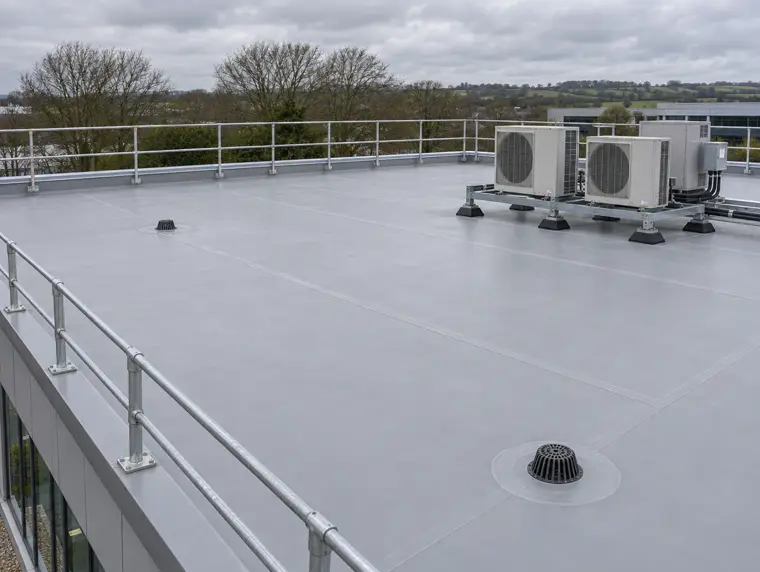
On exposed sites in Reading and elsewhere, mechanically fixed single-ply is specified with a fixing pattern based on wind uplift, with extra fasteners at corners and edges. That makes it a strong option for commercial roofs where wind loads are a concern.
Around Reading, flat roofs are common on terraced streets with flat-roofed rear kitchens and bathrooms and on 1930s semis with flat-roofed garages and kitchen extensions. Much of the South East sits in the drier Thames catchment at roughly 730 mm of rain a year, so the usual failures are at joints, upstands and outlets rather than from sheer volume of rain.
How much does a single-ply roof cost in Reading?
Guide price in Reading: £14,550–£23,950 for a 100 m² commercial roof in single-ply with insulation, including VAT at South East rates. The fixed price comes after a free survey for new and replacement roofs.
| Job | Guide price inc VAT |
|---|---|
| Commercial roof (100 m²), single-ply + insulation | £14,550–£23,950 |
| Single garage (18 m²), single-ply | £2,250–£3,650 |
| Single garage (18 m²), EPDM rubber | £1,750–£3,100 |
| Extension (20 m²), EPDM, new deck + insulation | £3,100–£5,350 |
Should a single-ply roof be mechanically fixed or adhered, and how are the seams welded?
Most commercial single-ply roofs are mechanically fixed, while adhered systems suit decks that cannot take fixings or roofs where a smooth finish is wanted. The choice depends on the deck, the wind exposure of the site and the manufacturer's specification.
| Method | How it works | Typical use |
|---|---|---|
| Mechanically fixed | Fasteners and plates hold the membrane through the insulation into the deck, hidden under the lap of the next sheet | Metal, timber and concrete decks on commercial roofs |
| Adhered | Membrane bonded to the insulation or deck with adhesive | Domestic roofs, roofs where fixings are unsuitable |
| Ballasted | Loose-laid and held down by paving, gravel or a green roof | Inverted roofs, terraces, green roofs |
Fixing patterns are worked out for the site, with more fasteners at corners and perimeters, where wind uplift is strongest.
Seams are welded by hot-air machines and hand tools that melt the overlapping edges so they fuse. Each seam is then probed along its length to find any gaps, and test welds are made at the start of the day to set the machine for the weather. On commercial jobs we also check that walkways protect the membrane around plant.
What's included?
- Strip-out or preparation of the existing roof, with waste removed
- Edge protection on every job and walkway protection around plant
- Hot-air welded seams, each probed along its full length
- Welded details at upstands, outlets, rooflight kerbs and edge trims
Building regulations in England
Replacing more than half of a flat roof over a heated room usually counts as renovating a thermal element, so the roof is insulated to around 0.16 W/m²K where that's technically and economically feasible, and the work is notified to building control: the council or a registered building control approver, unless a registered competent person self-certifies it. A roof on a new extension is built to 0.15 W/m²K. Patch repairs, and most unheated detached garages, don't trigger the upgrade. Structural changes, or a new covering that adds 15% or more to the roof's weight, also need approval. More on the rules.
Which nearby areas do we also cover?
Single-ply membrane roofing in Reading: questions
Do you cover Reading?
Yes. Reading is part of our Berkshire coverage, including postcode districts RG1, RG2, RG4, RG6, RG30, RG31. Surveys and roofs are carried out by vetted roofing teams working under S&K Property Investments and Improvement Ltd.
Who checks building regulations for a flat roof in Reading?
Where the work needs approval it goes to Reading Borough Council building control, or a registered building control approver. We tell you at the survey whether your job needs it and deal with the paperwork as part of the quote.
How much does a single-ply roof cost in Reading?
£14,550–£23,950 for a 100 m² commercial roof in single-ply with insulation, at South East guide rates including VAT. The fixed price comes after a free survey for new and replacement roofs.
How long does a commercial single-ply roof take?
A roof of around 100 m² typically takes several days, depending on strip-out, insulation, details and weather. Work is phased so the building stays weathertight and occupied areas are protected.
Can single-ply be used on a house?
Yes. It can be used on garages, extensions and dormers, usually adhered rather than mechanically fixed. On small domestic roofs, though, EPDM or GRP is often more economical.