- Price per m²
- £83–£133
- Typical life
- 25–35+ years
- Manufacturer guarantees
- 20–25 year guarantees on specified systems
- Typical garage roof
- £1,900–£3,050
Pembrokeshire at a glance
- Largest towns
- Haverfordwest, Milford Haven, Pembroke Dock, Pembroke
- Postcode areas
- SA
- Building control
- Pembrokeshire County Council
- Neighbouring areas
- Carmarthenshire · Swansea · Neath Port Talbot · Bridgend
- Guide price region
- Wales (−8% on West Midlands rates)
How much does a single-ply roof cost in Pembrokeshire?
Guide prices including VAT at Wales rates. The fixed price comes after a free survey for new and replacement roofs.
| Job | Guide price inc VAT |
|---|---|
| Commercial roof (100 m²), single-ply + insulation | £12,150–£20,050 |
| Single garage (18 m²), single-ply | £1,900–£3,050 |
| Single garage (18 m²), EPDM rubber | £1,450–£2,600 |
| Extension (20 m²), EPDM, new deck + insulation | £2,600–£4,500 |
Which flat roofs are common in Pembrokeshire?
Flat roofs in Pembrokeshire sit on lock-up garage blocks on estates, shops with flat-roofed rear stores below flats and low-rise post-war blocks of flats. Wales averages roughly 1,460 mm of rain a year, among the wettest in Britain, so we design for steady run-off: proper falls, clear outlets and upstands well above the finished roof. Approximate 1991–2020 regional averages based on Met Office data.
Building regulations in Wales
Welsh guidance is that most re-roofing needs building control approval, so it's worth checking whenever more than a quarter of a roof is replaced or repaired. Renovated roofs are upgraded to around 0.16 W/m²K where feasible, and new extension roofs are built to 0.13 W/m²K under the Welsh Approved Document L. In Pembrokeshire the application goes to Pembrokeshire County Council. More on the rules.
What insulation and approvals does a single-ply re-roof need?
On a heated building, a full single-ply re-roof usually triggers the thermal-element rules, so insulation should be brought towards the renovation standard where feasible. In England that is 0.18 W/m²K for non-domestic and 0.16 W/m²K for domestic roofs, with Wales and Northern Ireland setting their own figures; Scottish roofs follow Section 6 of the building standards, and the council confirms whether a building warrant is required.
Single-ply suits a warm roof well, and tapered insulation can correct poor falls at the same time. A thicker build-up raises the roof, so we check upstand heights, door thresholds and rooflight kerbs at survey. Near boundaries, the external fire classification of the tested build-up can matter. We handle building control or building standards where needed; see the building regulations page.
Is single-ply the right system for my roof?
Single-ply is usually the right system for medium and large flat roofs, such as shops, offices, units, surgeries, clubs and blocks, where speed of installation, light weight and long life matter. On a small domestic roof it can work well, though it is not always the most economical choice.
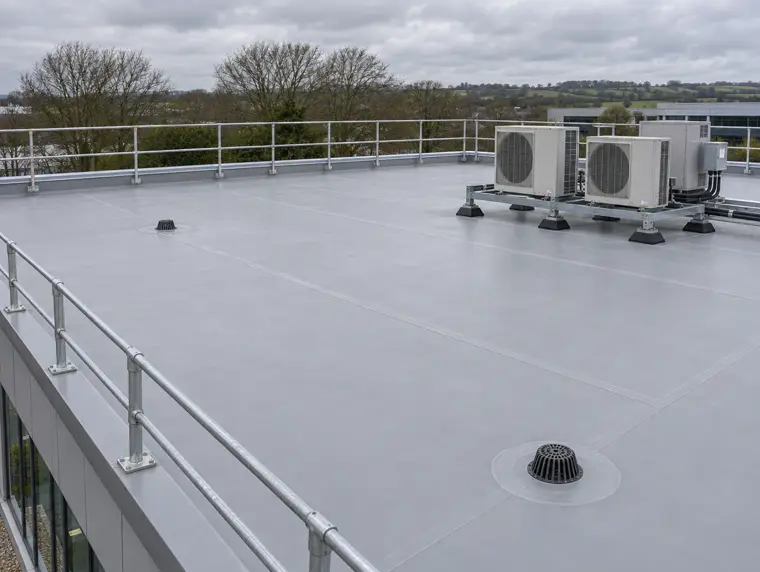
In its favour: lightweight; quick to lay over large areas; flame-free, as the seams are welded with hot air; long typical life; welded details at rooflights and plant; lighter-coloured membranes reflect more sunlight.
Against it: only one waterproof layer, so welding quality is critical; can be punctured by foot traffic or dropped tools without walkway protection; PVC needs separating from bitumen; repairs need compatible material and welding equipment.
For a small garage or extension, EPDM is often simpler. Where people walk regularly, GRP or a liquid system may be tougher. A multi-layer torch-on felt roof gives built-in redundancy, and on older buildings mastic asphalt may be the original material. Our commercial flat roofing page covers larger jobs.
Which towns in Pembrokeshire do we cover?
Single-ply membrane roofing in Pembrokeshire: questions
Which towns in Pembrokeshire do you cover?
All of Pembrokeshire. The main towns have their own pages below, and if yours isn't listed we still cover it: send your postcode and we'll confirm.
How much does a single-ply roof cost in Pembrokeshire?
£12,150–£20,050 for a 100 m² commercial roof in single-ply with insulation, at Wales guide rates including VAT. The fixed price comes after a free survey for new and replacement roofs.
Which council handles building control for a flat roof in Pembrokeshire?
It depends on where the roof is: in Pembrokeshire that's Pembrokeshire County Council. Welsh guidance is that most re-roofing needs building control approval, so it's worth checking whenever more than a quarter of a roof is replaced or repaired. We confirm which applies at the survey.
Does single-ply work with solar panels or a green roof?
Usually, yes. Many systems can be specified for sedum or ballasted green roofs, and solar mounts can be welded or ballasted, though the structure and wind loads must be checked first.
Can single-ply roofing be laid over an existing roof?
Sometimes, if the existing roof and deck are dry and sound, often with a separation layer or new insulation on top. Wet insulation or a damaged deck means stripping first.
Can a single-ply roof be repaired?
Yes. A compatible patch is cleaned and hot-air welded over the damage. Older membranes may need extra cleaning before they weld properly, which the team checks on site.
Everything about single-ply membrane roofing → · All flat roofing in Pembrokeshire →