Pembroke at a glance
- Postcode districts
- SA71
- Population
- about 7,552 (GeoNames)
- Council area
- Pembrokeshire County Council
- Building approval
- Pembrokeshire County Council building control, or a registered building control approver
- Nearest main town
- Haverfordwest, about 9 miles
- Guide price region
- Wales (−8% on West Midlands rates)
Why choose single-ply roofing in Pembroke?
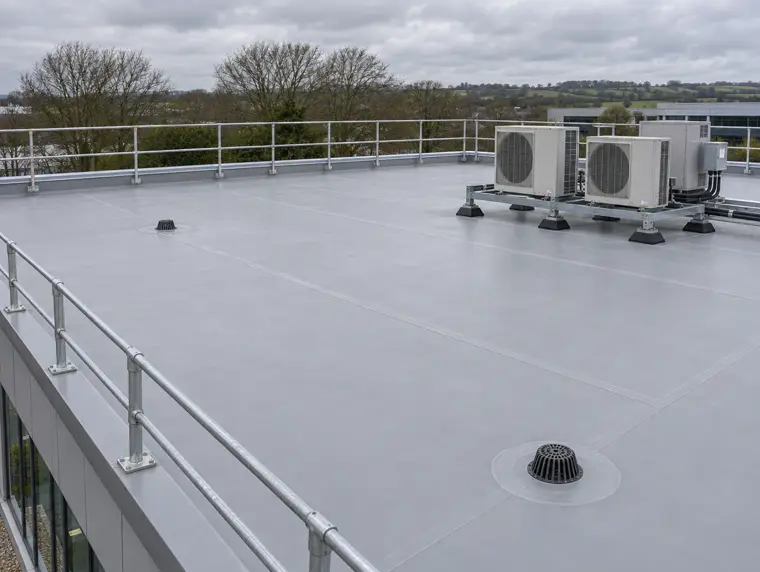
On exposed sites in Pembroke and elsewhere, mechanically fixed single-ply is specified with a fixing pattern based on wind uplift, with extra fasteners at corners and edges. That makes it a strong option for commercial roofs where wind loads are a concern.
Around Pembroke, flat roofs are common on newer estates where the first extension roofs are now being replaced and on bungalows with flat-roofed side extensions and dormers. Wales averages roughly 1,460 mm of rain a year, among the wettest in Britain, so we design for steady run-off: proper falls, clear outlets and upstands well above the finished roof.
How much does a single-ply roof cost in Pembroke?
For Pembroke we use Wales rates: £12,150–£20,050 is the guide for a 100 m² commercial roof in single-ply with insulation, VAT included. The fixed price comes after a free survey for new and replacement roofs.
| Job | Guide price inc VAT |
|---|---|
| Commercial roof (100 m²), single-ply + insulation | £12,150–£20,050 |
| Single garage (18 m²), single-ply | £1,900–£3,050 |
| Single garage (18 m²), EPDM rubber | £1,450–£2,600 |
| Extension (20 m²), EPDM, new deck + insulation | £2,600–£4,500 |
What insulation and approvals does a single-ply re-roof need?
On a heated building, a full single-ply re-roof usually triggers the thermal-element rules, so insulation should be brought towards the renovation standard where feasible. In England that is 0.18 W/m²K for non-domestic and 0.16 W/m²K for domestic roofs, with Wales and Northern Ireland setting their own figures; Scottish roofs follow Section 6 of the building standards, and the council confirms whether a building warrant is required.
Single-ply suits a warm roof well, and tapered insulation can correct poor falls at the same time. A thicker build-up raises the roof, so we check upstand heights, door thresholds and rooflight kerbs at survey. Near boundaries, the external fire classification of the tested build-up can matter. We handle building control or building standards where needed; see the building regulations page.
What's included?
- Hot-air welded seams, each probed along its full length
- PVC, TPO or FPO membrane, mechanically fixed, adhered or ballasted
- Strip-out or preparation of the existing roof, with waste removed
- Edge protection on every job and walkway protection around plant
Building regulations in Wales
The Welsh Approved Document L applies. Renovating more than half of a roof over a heated room means upgrading it to around 0.16 W/m²K where feasible, and new extension roofs are built to 0.13 W/m²K. Welsh Government guidance is that most re-roofing needs building control approval, so check whenever more than a quarter of a roof is replaced or repaired. We deal with the application as part of the job. More on the rules.
Which nearby areas do we also cover?
Single-ply membrane roofing in Pembroke: questions
Do you cover Pembroke?
Yes. Pembroke is part of our Pembrokeshire coverage, including postcode districts SA71. Surveys and roofs are carried out by vetted roofing teams working under S&K Property Investments and Improvement Ltd.
Who checks building regulations for a flat roof in Pembroke?
Where the work needs approval it goes to Pembrokeshire County Council building control, or a registered building control approver. We tell you at the survey whether your job needs it and deal with the paperwork as part of the quote.
How much does a single-ply roof cost in Pembroke?
£12,150–£20,050 for a 100 m² commercial roof in single-ply with insulation, at Wales guide rates including VAT. The fixed price comes after a free survey for new and replacement roofs.
Can single-ply be used on a house?
Yes. It can be used on garages, extensions and dormers, usually adhered rather than mechanically fixed. On small domestic roofs, though, EPDM or GRP is often more economical.
What is the difference between PVC and TPO roofing?
Both are thermoplastic single-ply membranes welded with hot air. PVC contains plasticisers and usually needs separating from bitumen, while TPO and FPO are polyolefin-based; the right one depends on the roof and the system specified.