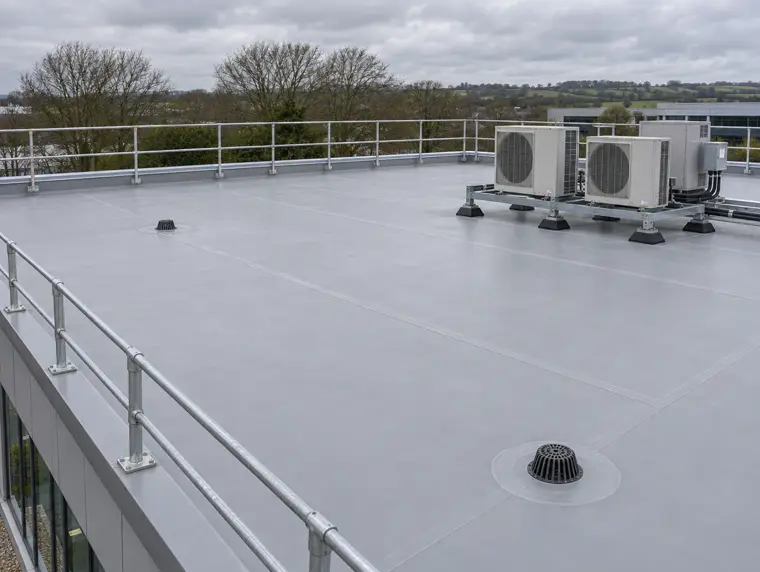
- Price per m²
- £99–£160
- Typical life
- 25–35+ years
- Manufacturer guarantees
- 20–25 year guarantees on specified systems
- Typical garage roof
- £2,250–£3,650
West Sussex at a glance
- Largest towns
- Crawley, Worthing, Bognor Regis, Littlehampton
- Postcode areas
- BN, PO, RH
- Building control
- Crawley Borough Council, Worthing Borough Council, Arun District Council and 4 other councils
- Neighbouring areas
- East Sussex · Surrey · Hampshire · London
- Guide price region
- South East (+10% on West Midlands rates)
How much does a single-ply roof cost in West Sussex?
Guide prices including VAT at South East rates. The fixed price comes after a free survey for new and replacement roofs.
| Job | Guide price inc VAT |
|---|---|
| Commercial roof (100 m²), single-ply + insulation | £14,550–£23,950 |
| Single garage (18 m²), single-ply | £2,250–£3,650 |
| Single garage (18 m²), EPDM rubber | £1,750–£3,100 |
| Extension (20 m²), EPDM, new deck + insulation | £3,100–£5,350 |
Which flat roofs are common in West Sussex?
Flat roofs in West Sussex sit on bungalows with flat-roofed side extensions and dormers, 1930s semis with flat-roofed garages and kitchen extensions and 1960s and 1970s link-detached houses with flat-roofed garages and porches. Much of the South East sits in the drier Thames catchment at roughly 730 mm of rain a year, so the usual failures are at joints, upstands and outlets rather than from sheer volume of rain. Approximate 1991–2020 regional averages based on Met Office data.
Building regulations in England
Replacing more than half of a roof over a heated room usually counts as renovating a thermal element, so it is insulated to current standards and notified to building control. Renovated roofs over heated rooms are insulated to around 0.16 W/m²K where that's feasible, and new extension roofs are built to 0.15 W/m²K. In West Sussex the application goes to Crawley Borough Council, Worthing Borough Council, Arun District Council and 4 other councils. More on the rules.
Is single-ply the right system for my roof?
Single-ply is usually the right system for medium and large flat roofs, such as shops, offices, units, surgeries, clubs and blocks, where speed of installation, light weight and long life matter. On a small domestic roof it can work well, though it is not always the most economical choice.
In its favour: lightweight; quick to lay over large areas; flame-free, as the seams are welded with hot air; long typical life; welded details at rooflights and plant; lighter-coloured membranes reflect more sunlight.
Against it: only one waterproof layer, so welding quality is critical; can be punctured by foot traffic or dropped tools without walkway protection; PVC needs separating from bitumen; repairs need compatible material and welding equipment.
For a small garage or extension, EPDM is often simpler. Where people walk regularly, GRP or a liquid system may be tougher. A multi-layer torch-on felt roof gives built-in redundancy, and on older buildings mastic asphalt may be the original material. Our commercial flat roofing page covers larger jobs.
Should a single-ply roof be mechanically fixed or adhered, and how are the seams welded?
Most commercial single-ply roofs are mechanically fixed, while adhered systems suit decks that cannot take fixings or roofs where a smooth finish is wanted. The choice depends on the deck, the wind exposure of the site and the manufacturer's specification.
| Method | How it works | Typical use |
|---|---|---|
| Mechanically fixed | Fasteners and plates hold the membrane through the insulation into the deck, hidden under the lap of the next sheet | Metal, timber and concrete decks on commercial roofs |
| Adhered | Membrane bonded to the insulation or deck with adhesive | Domestic roofs, roofs where fixings are unsuitable |
| Ballasted | Loose-laid and held down by paving, gravel or a green roof | Inverted roofs, terraces, green roofs |
Fixing patterns are worked out for the site, with more fasteners at corners and perimeters, where wind uplift is strongest.
Seams are welded by hot-air machines and hand tools that melt the overlapping edges so they fuse. Each seam is then probed along its length to find any gaps, and test welds are made at the start of the day to set the machine for the weather. On commercial jobs we also check that walkways protect the membrane around plant.
Which towns in West Sussex do we cover?
- Crawley
- Worthing
- Bognor Regis
- Littlehampton
- Horsham
- Haywards Heath
- Chichester
- Burgess Hill
- East Grinstead
- Shoreham-by-Sea
- Lancing
Single-ply membrane roofing in West Sussex: questions
Which towns in West Sussex do you cover?
All of West Sussex. The main towns have their own pages below, and if yours isn't listed we still cover it: send your postcode and we'll confirm.
How much does a single-ply roof cost in West Sussex?
£14,550–£23,950 for a 100 m² commercial roof in single-ply with insulation, at South East guide rates including VAT. The fixed price comes after a free survey for new and replacement roofs.
Which postcode areas do you cover in West Sussex?
All of West Sussex, including the BN, PO, RH postcode areas. Send your full postcode and we'll confirm.
Can single-ply be used on a house?
Yes. It can be used on garages, extensions and dormers, usually adhered rather than mechanically fixed. On small domestic roofs, though, EPDM or GRP is often more economical.
Can single-ply roofing be laid over an existing roof?
Sometimes, if the existing roof and deck are dry and sound, often with a separation layer or new insulation on top. Wet insulation or a damaged deck means stripping first.
How long does a commercial single-ply roof take?
A roof of around 100 m² typically takes several days, depending on strip-out, insulation, details and weather. Work is phased so the building stays weathertight and occupied areas are protected.
Everything about single-ply membrane roofing → · All flat roofing in West Sussex →