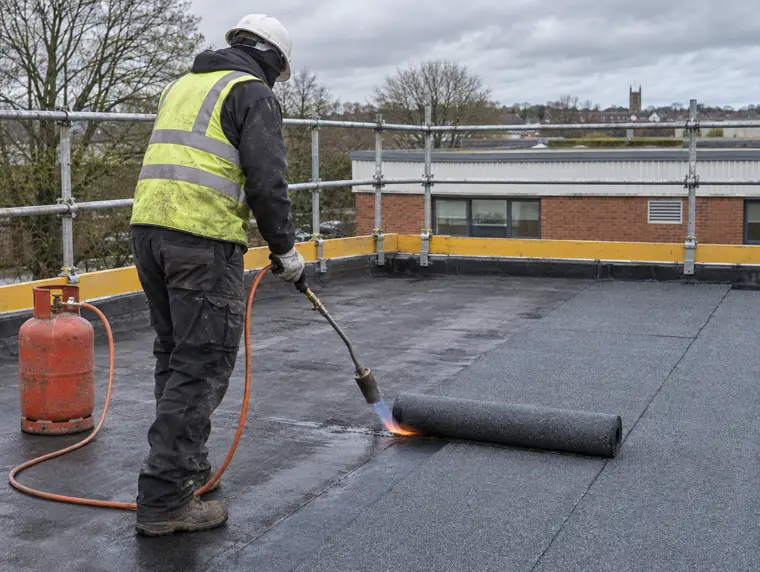
- Price per m²
- £57–£100
- Typical life
- 15–25 years
- Manufacturer guarantees
- 10–20 year material guarantees on specified systems
- Typical garage roof
- £1,450–£2,500
Lancashire at a glance
- Largest towns
- Preston, Burnley, Blackburn, Blackpool
- Postcode areas
- BB, FY, L, LA, OL, PR, WN
- Building control
- Preston City Council, Burnley Borough Council, Blackburn with Darwen Borough Council and 10 other councils
- Neighbouring areas
- Greater Manchester · Merseyside · Cheshire · West Yorkshire
- Guide price region
- North West (−5% on West Midlands rates)
How much does a torch-on felt roof cost in Lancashire?
Guide prices including VAT at North West rates. The fixed price comes after a free survey for new and replacement roofs.
| Job | Guide price inc VAT |
|---|---|
| Single garage (18 m²), torch-on felt | £1,450–£2,500 |
| Extension (20 m²), felt, new deck + insulation | £2,550–£4,450 |
| Block of flats (150 m²), felt + insulation + scaffold | £14,750–£25,850 |
| Single garage (18 m²), EPDM rubber | £1,500–£2,650 |
| Extension (20 m²), EPDM, new deck + insulation | £2,650–£4,650 |
Which flat roofs are common in Lancashire?
Flat roofs in Lancashire sit on 1930s semis with flat-roofed garages and kitchen extensions, terraced streets with flat-roofed rear kitchens and bathrooms and lock-up garage blocks on estates. The North West is one of England's wetter regions, averaging roughly 1,290 mm of rain a year, so falls, outlets and well-detailed upstands matter more than the membrane colour. Approximate 1991–2020 regional averages based on Met Office data.
Building regulations in England
Replacing more than half of a roof over a heated room usually counts as renovating a thermal element, so it is insulated to current standards and notified to building control. Renovated roofs over heated rooms are insulated to around 0.16 W/m²K where that's feasible, and new extension roofs are built to 0.15 W/m²K. In Lancashire the application goes to Preston City Council, Burnley Borough Council, Blackburn with Darwen Borough Council and 10 other councils. More on the rules.
How long does a torch-on felt roof last, and what is the guarantee?
A modern torch-on roof typically lasts 15 to 25 years, and high-performance systems with better membranes can last longer. That is a big step up from older felt roofs, which were often single-layer, unreinforced or poorly bonded.
What shortens the life of a felt roof is usually visible: mineral chippings worn away so the bitumen is exposed to sunlight, blisters where moisture was trapped, split laps, and upstands that have slumped or pulled away from the wall. Ponding speeds all of this up.
Manufacturer material guarantees are available on many specified torch-on systems; they often depend on a particular build-up and registration, which we handle where the system allows. Every re-roof also comes with our written workmanship guarantee, the length of which is stated in the quote, and insurance-backed options can be discussed. Our flat roof lifespan guide compares felt with the other systems.
Should I choose torch-on felt or a different flat roof system?
Choose torch-on felt when you want a proven, layered system at a sensible price, particularly on larger roofs, blocks of flats and commercial buildings where several layers give useful redundancy. It is a weaker choice where hot works are hard to manage safely.
For: generally lower cost per square metre; two or three layers, so a single defect in one layer need not cause a leak; tough mineral finish; long track record and a British Standard code of practice; repairs can be made with compatible materials.
Against: needs a naked flame unless a cold-applied or self-adhesive alternative is used; shorter typical life than EPDM or GRP; the finish is functional rather than decorative; more laps to detail than a single sheet.
On small domestic roofs near timber, EPDM avoids the torch entirely. GRP gives a harder, neater surface. For an overlay, a liquid-applied system is often simpler. Large commercial roofs may suit single-ply, and older buildings may suit mastic asphalt. See our comparison guide.
Which towns in Lancashire do we cover?
- Preston
- Burnley
- Blackburn
- Blackpool
- Morecambe
- Lancaster
- Lytham St Annes
- Skelmersdale
- Leyland
- Accrington
- Chorley
- Darwen
- Thornton-Cleveleys
- Nelson
- Fleetwood
- Ormskirk
- Rawtenstall
- Colne
- Poulton-le-Fylde
- Heysham
- Haslingden
Torch-on felt roofing in Lancashire: questions
Which towns in Lancashire do you cover?
All of Lancashire. The main towns have their own pages below, and if yours isn't listed we still cover it: send your postcode and we'll confirm.
How much does a torch-on felt roof cost in Lancashire?
£1,450–£2,500 for a typical 18 m² garage roof in torch-on felt, at North West guide rates including VAT. The fixed price comes after a free survey for new and replacement roofs.
Which postcode areas do you cover in Lancashire?
All of Lancashire, including the BB, FY, L, LA, OL, PR, WN postcode areas. Send your full postcode and we'll confirm.
Is torch-on suitable for a block of flats?
Yes, layered bitumen systems are widely used on blocks of flats and commercial buildings. Larger roofs often use three layers and insulation, with hot works planned around residents.
Can I paint or coat an old felt roof?
Reflective or liquid coatings can extend the life of a sound felt roof, but they will not fix wet insulation, a rotten deck or poor falls. A survey shows whether coating or replacement makes more sense.
Is torch-on felt better than the old felt roofs?
Yes, considerably. Modern torch-on membranes are polymer-modified and polyester-reinforced, laid in bonded layers, and typically last much longer than the older felt systems they replace.
Everything about torch-on felt roofing → · All flat roofing in Lancashire →