Mold at a glance
- Postcode districts
- CH7
- Population
- about 10,058 (GeoNames)
- Council area
- Flintshire County Council
- Building approval
- Flintshire County Council building control, or a registered building control approver
- Nearest main town
- Buckley, about 2 miles
- Guide price region
- Wales (−8% on West Midlands rates)
Why upgrade to a warm roof in Mold?
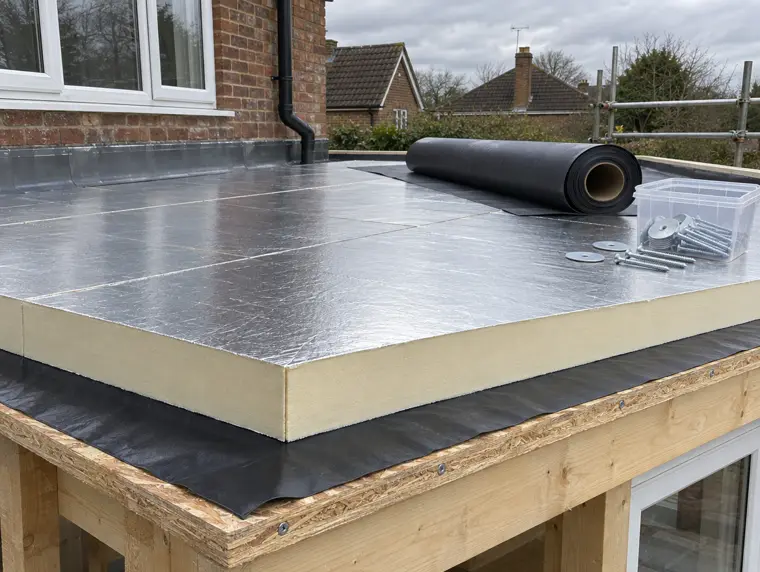
Converting a garage, loft space or outbuilding to a room in Mold changes what the roof needs to do. Once the space is heated, the roof is expected to perform to a higher standard, and a warm build-up is usually the simplest way to get there.
In a town like Mold, flat roofs are commonly found on bungalows with flat-roofed side extensions and dormers or shops with flat-roofed rear stores below flats. Wales averages roughly 1,460 mm of rain a year, among the wettest in Britain, so we design for steady run-off: proper falls, clear outlets and upstands well above the finished roof.
How much does a warm roof upgrade cost in Mold?
For Mold we use Wales rates: £2,600–£4,500 is the guide for a 20 m² extension roof in EPDM with a new deck and insulation, VAT included. The fixed price comes after a free survey for new and replacement roofs.
| Job | Guide price inc VAT |
|---|---|
| Extension (20 m²), EPDM, new deck + insulation | £2,600–£4,500 |
| Extension (20 m²), EPDM with sedum green roof | £4,050–£7,450 |
Can a cold flat roof be converted to a warm roof?
Yes, and it is the usual approach when an older cold roof is re-covered. The old covering is stripped, the deck is checked and replaced where needed, and the vapour control layer, insulation and new waterproofing go on top.
The existing insulation between the joists is assessed at the same time. Leaving it in place can create a cold, unventilated gap that traps moisture, so it is often removed or the build-up is designed so that most of the insulation sits above the deck. We decide this case by case once we can see inside the roof. If the covering is still sound and you are only patching it, the upgrade isn't usually required, and our repair or replace guide explains how to decide between the two.
What's included?
- Rigid insulation boards sized to the U-value target
- Building control or building standards handled where needed
- New waterproofing, with a written workmanship guarantee
- Survey of the deck, joists and existing insulation
Building regulations in Wales
The Welsh Approved Document L applies. Renovating more than half of a roof over a heated room means upgrading it to around 0.16 W/m²K where feasible, and new extension roofs are built to 0.13 W/m²K. Welsh Government guidance is that most re-roofing needs building control approval, so check whenever more than a quarter of a roof is replaced or repaired. We deal with the application as part of the job. More on the rules.
Which nearby areas do we also cover?
Warm roof insulation upgrades in Mold: questions
Do you cover Mold?
Yes. Mold is part of our Flintshire coverage, including postcode districts CH7. Surveys and roofs are carried out by vetted roofing teams working under S&K Property Investments and Improvement Ltd.
Who checks building regulations for a flat roof in Mold?
Where the work needs approval it goes to Flintshire County Council building control, or a registered building control approver. We tell you at the survey whether your job needs it and deal with the paperwork as part of the quote.
How much does a warm roof upgrade cost in Mold?
£2,600–£4,500 for a 20 m² extension roof in EPDM with a new deck and insulation, at Wales guide rates including VAT. The fixed price comes after a free survey for new and replacement roofs.
Can you add insulation over my existing roof without stripping it?
Sometimes, if the existing covering and deck are dry and sound. We will check at the survey and explain the risks, and our overlay or strip guide covers this choice.
Can you insulate a flat roof from inside instead?
It is possible, but insulating between or under the joists creates a cold roof, which needs ventilation and carries a higher condensation risk. When the roof is being re-covered anyway, a warm roof from above is usually the better option.