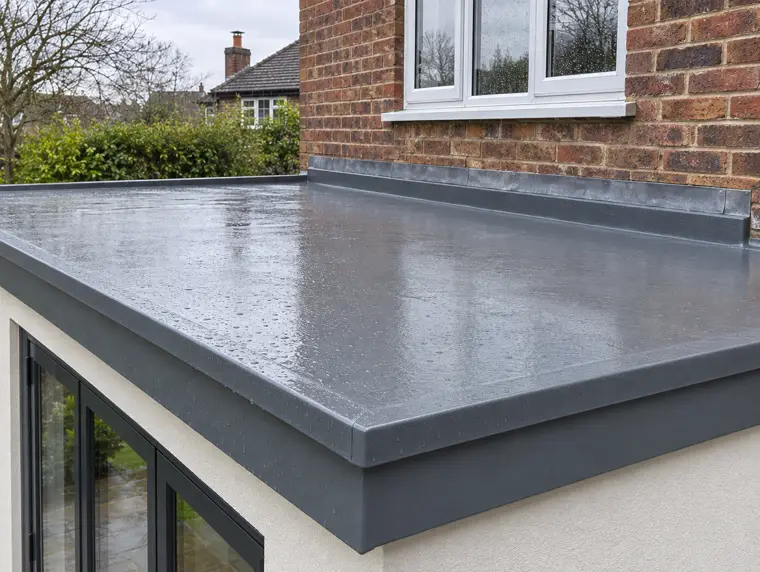
- Price per m²
- £77–£144
- Typical life
- 20–40 years
- Manufacturer guarantees
- 20–25 year material warranties on specified systems
- Typical garage roof
- £1,850–£3,350
Devon at a glance
How much does a GRP fibreglass roof cost in Devon?
Guide prices including VAT at South West rates. The fixed price comes after a free survey for new and replacement roofs.
| Job | Guide price inc VAT |
|---|---|
| Extension (20 m²), GRP, new deck + insulation | £3,100–£5,550 |
| Dormer (8 m²), GRP, scaffold | £1,450–£2,750 |
| Single garage (18 m²), GRP fibreglass | £1,850–£3,350 |
| Single garage (18 m²), EPDM rubber | £1,650–£2,900 |
| Extension (20 m²), EPDM, new deck + insulation | £2,900–£5,050 |
Which flat roofs are common in Devon?
Flat roofs in Devon sit on low-rise post-war blocks of flats, terraced streets with flat-roofed rear kitchens and bathrooms and bungalows with flat-roofed side extensions and dormers. The South West averages roughly 1,260 mm of rain a year and many roofs face wind off the Atlantic, so we specify fixings and edge details for wind uplift as well as drainage. Approximate 1991–2020 regional averages based on Met Office data.
Building regulations in England
Replacing more than half of a roof over a heated room usually counts as renovating a thermal element, so it is insulated to current standards and notified to building control. Renovated roofs over heated rooms are insulated to around 0.16 W/m²K where that's feasible, and new extension roofs are built to 0.15 W/m²K. In Devon the application goes to Plymouth City Council, Exeter City Council, Torbay Council and 5 other councils. More on the rules.
Why do GRP roofs crack, and can weather affect the installation?
GRP usually cracks where the structure moves and the laminate cannot, typically along board joints, at the junction with trims, or where a roof meets a wall. Weather during laying is the other big factor, because resin cures by chemical reaction and that reaction is sensitive to temperature and moisture.
How we reduce the risk of cracking:
- boards fixed at close centres so the deck does not flex;
- joints taped and reinforced with an extra strip of mat;
- wall junctions finished with a separate trim or flashing, not laminated hard into the masonry;
- roofs over a certain size divided with movement details where the system calls for them.
And how weather is managed:
- no laminating in rain, on a damp deck, or when dew or frost is likely before the resin sets;
- catalyst levels adjusted for the temperature, so resin neither stays tacky on a cold day nor kicks too fast in summer heat;
- the roof sheeted over if a shower threatens a fresh laminate.
That is why a GRP date can move at short notice. A day's delay costs far less than a laminate that never cures properly.
Will a new GRP roof need extra insulation to meet building regulations?
If the roof is over a heated room and you are replacing more than half of it, usually yes. In England, Wales and Northern Ireland that counts as renovating a thermal element, and in Scotland the council's building standards service will say whether a building warrant applies.
GRP pairs well with a warm roof because the new deck boards it needs can sit on top of the insulation. The result is thicker, so we check at survey that there is room under door cills and wall flashings, and that the upstands can finish around 150 mm above the new surface. Where approval is needed we arrange it with building control or building standards.
Unheated, detached garages normally sit outside the thermal rules. See the building regulations page for each nation, or the warm vs cold roof guide for why we avoid cold roofs where we can.
Which towns in Devon do we cover?
GRP fibreglass roofing in Devon: questions
Which towns in Devon do you cover?
All of Devon. The main towns have their own pages below, and if yours isn't listed we still cover it: send your postcode and we'll confirm.
How much does a GRP fibreglass roof cost in Devon?
£3,100–£5,550 for a 20 m² extension roof in GRP with a new deck and insulation, at South West guide rates including VAT. The fixed price comes after a free survey for new and replacement roofs.
Which postcode areas do you cover in Devon?
All of Devon, including the EX, PL, TQ postcode areas. Send your full postcode and we'll confirm.
Can a cracked GRP roof be repaired?
Often, yes. The area is ground back, cleaned and re-laminated with fresh mat and topcoat. If cracks keep returning along joints, the deck or detailing usually needs attention rather than another patch.
What colours does a GRP roof come in?
Topcoats are typically available in greys, greens, black and some other shades. Lighter colours absorb less heat, and an anti-slip finish can be added where people will walk on the roof.
How long before a new GRP roof is fully cured?
The topcoat is usually touch-dry within hours in reasonable weather, but full cure takes longer in cold conditions. We advise keeping off the roof until the team confirms it is ready.
Everything about GRP fibreglass roofing → · All flat roofing in Devon →