- Price per m²
- £95–£147
- Typical life
- 10–25+ years by product
- Manufacturer guarantees
- 10, 15 or 20-year guarantees by named system
- Typical garage roof
- £2,150–£3,400
Essex at a glance
- Largest towns
- Southend-on-Sea, Basildon, Colchester, Chelmsford
- Postcode areas
- CB, CM, CO, EN, RM, SS
- Building control
- Southend-on-Sea City Council, Basildon Council, Colchester City Council and 11 other councils
- Neighbouring areas
- Kent · London · Hertfordshire · Suffolk
- Guide price region
- East of England (+5% on West Midlands rates)
How much does a liquid-applied roof cost in Essex?
Guide prices including VAT at East of England rates. The fixed price comes after a free survey for new and replacement roofs.
| Job | Guide price inc VAT |
|---|---|
| Single garage (18 m²), liquid-applied | £2,150–£3,400 |
| Balcony (12 m²), liquid-applied, scaffold | £2,000–£3,400 |
| Single garage (18 m²), EPDM rubber | £1,700–£2,950 |
| Extension (20 m²), EPDM, new deck + insulation | £2,950–£5,150 |
Which flat roofs are common in Essex?
Flat roofs in Essex sit on 1960s and 1970s link-detached houses with flat-roofed garages and porches, lock-up garage blocks on estates and terraced streets with flat-roofed rear kitchens and bathrooms. The East of England is the driest part of Britain, with parts of the Anglian region around 630 mm a year, so summer heat and UV, not rainfall, do most of the ageing on a felt roof. Approximate 1991–2020 regional averages based on Met Office data.
Building regulations in England
Replacing more than half of a roof over a heated room usually counts as renovating a thermal element, so it is insulated to current standards and notified to building control. Renovated roofs over heated rooms are insulated to around 0.16 W/m²K where that's feasible, and new extension roofs are built to 0.15 W/m²K. In Essex the application goes to Southend-on-Sea City Council, Basildon Council, Colchester City Council and 11 other councils. More on the rules.
Do building regulations apply if a liquid coating goes over my roof?
They can. In England, Wales and Northern Ireland, re-covering more than half of a roof over a heated room is usually renovation of a thermal element, even when the new membrane goes over the old, so the roof should be insulated towards the renovation standard where feasible; for a Scottish property, the local building standards team will confirm whether a warrant is required.
A minor coating repair to a small area is different from re-covering the whole roof. Where insulation is needed, an overlay is not always practical, because the insulation has to go under a new waterproof layer. In that case we may recommend stripping to the deck, fitting a warm roof and applying the liquid system on top. Where approval applies, we deal with the paperwork; details are on the building regulations page.
Can a liquid roof go over my existing roof, and what preparation is needed?
Yes, if the existing roof is dry, firmly bonded and sitting on a sound deck. A liquid membrane is only as good as what lies beneath it, so we test the old roof before agreeing to overlay it.
At survey we check for:
- Trapped moisture: soft spots, blisters or wet insulation mean the roof should be stripped, because water sealed in will cause new blisters and decay.
- Deck condition: any sponginess or deflection needs repair first.
- Adhesion: on felt and asphalt, loose areas are cut out and patched, and the existing surface must take the primer properly.
- Falls and ponding: a coating follows the roof as it is. If water ponds now, it will pond on the new surface too unless the falls are corrected.
Preparation then follows: loose chippings removed, the surface cleaned and left to dry, blisters cut back and repaired, cracks filled, and the right primer applied. On older felt, mineral surfaces may need extra cleaning to give a good bond. Where the tests fail, we say so plainly and quote for a strip and re-roof. Read more on ponding water.
Which towns in Essex do we cover?
- Southend-on-Sea
- Basildon
- Colchester
- Chelmsford
- Harlow
- Grays
- Braintree
- Brentwood
- Clacton-on-Sea
- South Benfleet
- Canvey Island
- Billericay
- Rayleigh
- Stanford-le-Hope
- Wickford
- Witham
- Pitsea
- Maldon
- Waltham Abbey
- South Ockendon
- Harwich
- Hadleigh
- Walton-on-the-Naze
- Frinton-on-Sea
- Rochford
- Saffron Walden
Liquid-applied roofing in Essex: questions
Which towns in Essex do you cover?
All of Essex. The main towns have their own pages below, and if yours isn't listed we still cover it: send your postcode and we'll confirm.
How much does a liquid-applied roof cost in Essex?
£2,150–£3,400 for a typical 18 m² garage roof in a liquid-applied system, at East of England guide rates including VAT. The fixed price comes after a free survey for new and replacement roofs.
Which council handles building control for a flat roof in Essex?
It depends on where the roof is: in Essex that's Southend-on-Sea City Council, Basildon Council, Colchester City Council and 11 other councils. Replacing more than half of a roof over a heated room usually counts as renovating a thermal element, so it is insulated to current standards and notified to building control. We confirm which applies at the survey.
What is a fleece-reinforced liquid roof?
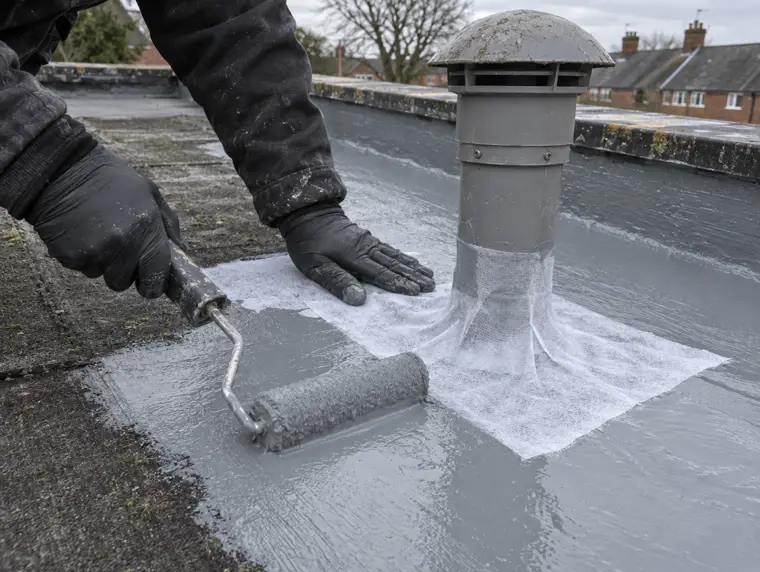
It is a liquid membrane with a polyester fleece embedded between coats. The fleece adds strength, helps control thickness and resists cracking where the surface moves slightly.
Does a liquid roof smell when it is applied?
Some systems, particularly PMMA, have a strong odour during application, while many polyurethane and water-based products are milder. We tell you what to expect and plan around windows and vents.
Is liquid roofing the same as a roof paint?
No. A proper liquid-applied membrane is built to a specified thickness and usually reinforced with fleece, while roof paints and simple coatings are much thinner and mainly used to extend the life of an existing covering.
Everything about liquid-applied roofing → · All flat roofing in Essex →