- Price per m²
- £108–£168
- Typical life
- 10–25+ years by product
- Manufacturer guarantees
- 10, 15 or 20-year guarantees by named system
- Typical garage roof
- £2,450–£3,900
London at a glance
- Largest towns
- Westminster, Camden, Islington, Haringey
- Postcode areas
- BR, CR, DA, E, EC, EN, HA, IG, KT, N
- Building control
- City of Westminster, London Borough of Camden, London Borough of Islington and 29 other councils
- Neighbouring areas
- Surrey · Hertfordshire · Buckinghamshire · Berkshire
- Guide price region
- London (+20% on West Midlands rates)
How much does a liquid-applied roof cost in London?
Guide prices including VAT at London rates. The fixed price comes after a free survey for new and replacement roofs.
| Job | Guide price inc VAT |
|---|---|
| Single garage (18 m²), liquid-applied | £2,450–£3,900 |
| Balcony (12 m²), liquid-applied, scaffold | £2,300–£3,900 |
| Single garage (18 m²), EPDM rubber | £1,900–£3,350 |
| Extension (20 m²), EPDM, new deck + insulation | £3,350–£5,850 |
Which flat roofs are common in London?
Flat roofs in London sit on kitchen extensions and roof terraces behind period houses, Victorian and Edwardian terraces with flat-roofed back additions and mansion blocks and purpose-built flats with large flat roofs. The Thames basin is one of the drier parts of Britain at roughly 730 mm of rain a year, but summer heat is the bigger test here: dark membranes on south-facing roofs swing a long way in temperature. Approximate 1991–2020 regional averages based on Met Office data.
Building regulations in England
Replacing more than half of a roof over a heated room usually counts as renovating a thermal element, so it is insulated to current standards and notified to building control. Renovated roofs over heated rooms are insulated to around 0.16 W/m²K where that's feasible, and new extension roofs are built to 0.15 W/m²K. In London the application goes to City of Westminster, London Borough of Camden, London Borough of Islington and 29 other councils. More on the rules.
Do building regulations apply if a liquid coating goes over my roof?
They can. In England, Wales and Northern Ireland, re-covering more than half of a roof over a heated room is usually renovation of a thermal element, even when the new membrane goes over the old, so the roof should be insulated towards the renovation standard where feasible; for a Scottish property, the local building standards team will confirm whether a warrant is required.
A minor coating repair to a small area is different from re-covering the whole roof. Where insulation is needed, an overlay is not always practical, because the insulation has to go under a new waterproof layer. In that case we may recommend stripping to the deck, fitting a warm roof and applying the liquid system on top. Where approval applies, we deal with the paperwork; details are on the building regulations page.
When is a liquid roof the best option, and when is it not?
A liquid roof is often the best option for roofs crowded with pipes, vents and upstands, for balconies and walkways, and for overlaying a structurally sound roof that is starting to fail. It is the wrong choice when the deck is rotten, the insulation is wet or the falls are badly wrong.
Advantages: continuous finish with no laps; forms details around pipes and odd shapes easily; cold-applied with no flame; can often go over felt, asphalt or concrete; some systems take foot traffic.
Disadvantages: higher cost per square metre than felt or EPDM; needs dry weather and careful thickness control; only as good as the surface it is bonded to; product quality varies widely across the market.
For a straightforward re-roof on a fresh deck, EPDM or GRP may offer better value. Larger flat areas suit torch-on felt or single-ply. On a sound mastic asphalt roof, a compatible liquid system can sometimes be applied over it. See also our guide to overlay or strip.
Which towns in London do we cover?
- Westminster
- Camden
- Islington
- Haringey
- Hounslow
- Barnet
- Bexley
- Lambeth
- Croydon
- Havering
- Lewisham
- Redbridge
- Southwark
- Bromley
- Ealing
- Hammersmith and Fulham
- Harrow
- Kensington and Chelsea
- Barking and Dagenham
- Brent
- Greenwich
- Hillingdon
- Kingston upon Thames
- Richmond upon Thames
- Sutton
- Waltham Forest
- Enfield
- Hackney
- Newham
- Tower Hamlets
- Merton
- Wandsworth
Liquid-applied roofing in London: questions
Which towns in London do you cover?
All of London. The main towns have their own pages below, and if yours isn't listed we still cover it: send your postcode and we'll confirm.
How much does a liquid-applied roof cost in London?
£2,450–£3,900 for a typical 18 m² garage roof in a liquid-applied system, at London guide rates including VAT. The fixed price comes after a free survey for new and replacement roofs.
Which council handles building control for a flat roof in London?
It depends on where the roof is: in London that's City of Westminster, London Borough of Camden, London Borough of Islington and 29 other councils. Replacing more than half of a roof over a heated room usually counts as renovating a thermal element, so it is insulated to current standards and notified to building control. We confirm which applies at the survey.
What is a fleece-reinforced liquid roof?
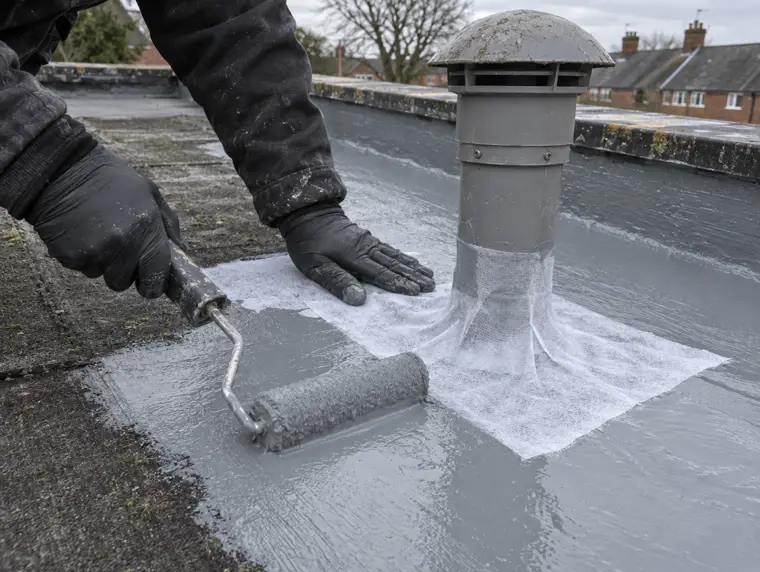
It is a liquid membrane with a polyester fleece embedded between coats. The fleece adds strength, helps control thickness and resists cracking where the surface moves slightly.
Is liquid roofing good for balconies?
Often, yes. It forms neatly around railings, door thresholds and drains, and some systems take foot traffic. A new balcony or roof terrace generally needs planning permission, so check before converting a roof.
Can liquid roofing stop a leak on a flat roof?
It can, if the leak is at a detail or the membrane is worn but the roof beneath is sound. If water has soaked the insulation or deck, coating over it will not cure the problem.
Everything about liquid-applied roofing → · All flat roofing in London →