- Guide price
- £120–£360
- Repair price
- Confirmed once the leak or damage is found
- Condition survey report
- £150–£310
- Coverage
- England, Wales, Scotland, NI
Gloucestershire at a glance
- Largest towns
- Gloucester, Cheltenham, Stroud, Kingswood
- Postcode areas
- BS, GL
- Building control
- Gloucester City Council, Cheltenham Borough Council, Stroud District Council and 3 other councils
- Neighbouring areas
- Bristol · Wiltshire · Herefordshire · Somerset
- Guide price region
- South West (+3% on West Midlands rates)
How much does a new roof edge or outlet cost in Gloucestershire?
Guide prices including VAT at South West rates. We confirm the price once we've traced the leak or seen the damage.
| Job | Guide price inc VAT |
|---|---|
| Outlet or drainage repair | £120–£360 |
| Localised patch repair | £150–£520 |
| Upstand or flashing repair | £260–£670 |
| Emergency temporary weatherproofing visit | £190–£460 |
| Condition survey and leak investigation | £150–£310 |
Which flat roofs are common in Gloucestershire?
Flat roofs in Gloucestershire sit on newer estates where the first extension roofs are now being replaced, 1930s semis with flat-roofed garages and kitchen extensions and shops with flat-roofed rear stores below flats. The South West averages roughly 1,260 mm of rain a year and many roofs face wind off the Atlantic, so we specify fixings and edge details for wind uplift as well as drainage. Approximate 1991–2020 regional averages based on Met Office data.
Building regulations in England
Replacing more than half of a roof over a heated room usually counts as renovating a thermal element, so it is insulated to current standards and notified to building control. Renovated roofs over heated rooms are insulated to around 0.16 W/m²K where that's feasible, and new extension roofs are built to 0.15 W/m²K. In Gloucestershire the application goes to Gloucester City Council, Cheltenham Borough Council, Stroud District Council and 3 other councils. More on the rules.
Should I fix the edges and drainage or replace the whole roof?
Fix the edges and drainage on their own if the covering is in good condition and the deck is sound. If the covering is near the end of its life or the falls need correcting across the whole roof, it is usually better value to do everything together as part of a replacement.
Trims and outlets are bonded into the waterproofing, so replacing them means cutting into the covering around the edge. On a roof with plenty of life left, that is a worthwhile repair. On an old, brittle covering, the new detail can end up stronger than the roof around it, and correcting falls means taking the covering off anyway. Our repair or replace guide sets out how to decide.
Why does water sit on my flat roof?
Water sits on a flat roof because it can't drain off fast enough: the falls are too shallow, part of the roof slopes the wrong way, the deck has sagged between joists, or an outlet is blocked or set too high.
Current guidance on flat roof design (BS 6229) means most roofs need to achieve a finished fall of at least 1:80, and roofs are commonly designed with a steeper fall, such as 1:60, so that building tolerances and deck deflection still leave enough slope. Many older roofs were built with less, or have settled over time.
A small amount of water that clears within a day or two of rain is often tolerable. Deeper ponding that lingers adds weight, holds dirt and debris, can shorten the life of some coverings and turns any small defect into a leak. A patch won't fix it, because the problem is the shape of the roof. The fix is to correct the falls, either with firring pieces under a new deck or with tapered insulation in a warm roof, or to add or lower outlets so water has somewhere to go. Our ponding water guide explains this in more detail.
Which towns in Gloucestershire do we cover?
Edge trims, outlets and drainage in Gloucestershire: questions
Which towns in Gloucestershire do you cover?
All of Gloucestershire. The main towns have their own pages below, and if yours isn't listed we still cover it: send your postcode and we'll confirm.
How much does a new roof edge or outlet cost in Gloucestershire?
£120–£360 for an outlet or drainage repair, at South West guide rates including VAT. We confirm the price once we've traced the leak or seen the damage.
Which postcode areas do you cover in Gloucestershire?
All of Gloucestershire, including the BS, GL postcode areas. Send your full postcode and we'll confirm.
Do new trims need building regulations approval?
Not usually on their own. Approval only becomes a question if the work is part of a larger re-roofing job or alters the structure.
Can you add a new outlet to an existing flat roof?
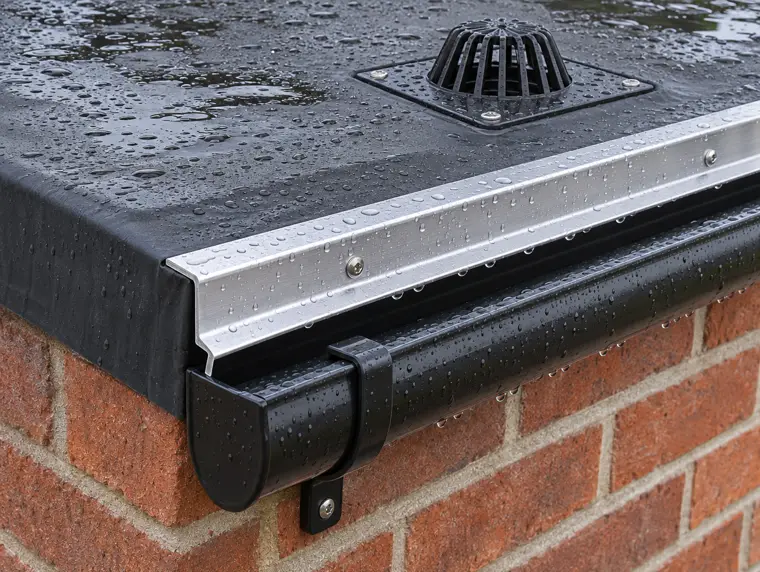
Usually, yes. The outlet is cut in at a low point, connected to a downpipe or gutter, and the waterproofing is dressed into it with compatible materials. Whether it solves ponding depends on whether water can actually reach it.
Is some standing water on a flat roof normal?
A thin film that clears within a day or two of rain is common and usually harmless. Deeper water that lingers for days points to poor falls, a sagging deck or a blocked outlet and should be looked at.
Everything about edge trims, outlets and drainage → · All flat roofing in Gloucestershire →