Dundonald at a glance
- Postcode districts
- BT16
- Population
- about 13,985 (GeoNames)
- Council area
- Lisburn and Castlereagh City Council
- Building approval
- Lisburn and Castlereagh City Council building control
- Nearest main town
- Belfast, about 5 miles
- Guide price region
- Northern Ireland (−12% on West Midlands rates)
Why choose torch-on felt roofing in Dundonald?
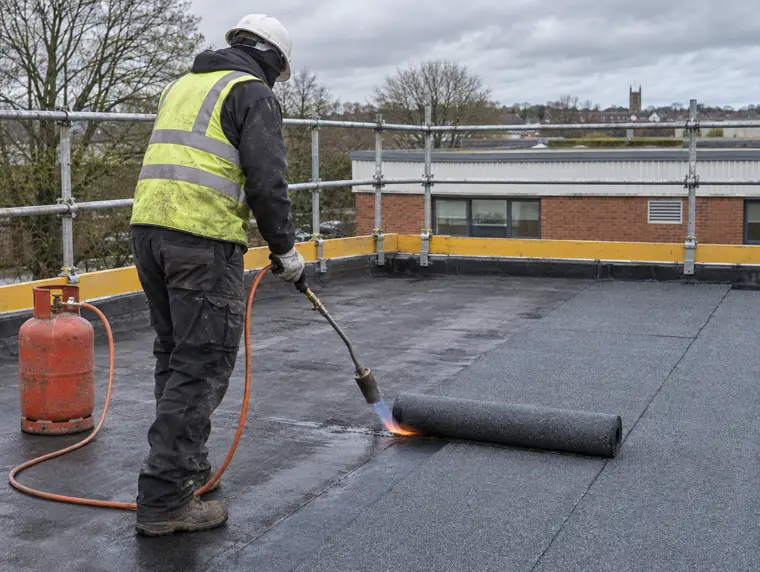
Torch-on is a good fit in Dundonald when the budget matters but quality cannot slip. Modern polyester-reinforced membranes typically last 15 to 25 years, high-performance systems longer, and manufacturer material guarantees are available on many specified systems, registered where the system allows.
Dundonald's flat roofs are mostly on 1930s semis with flat-roofed garages and kitchen extensions, with plenty on 1960s and 1970s link-detached houses with flat-roofed garages and porches too. Northern Ireland averages roughly 1,150 mm of rain a year, spread over many wet days, so a roof that sheds water quickly to clear outlets lasts far longer than one that holds puddles.
How much does a torch-on felt roof cost in Dundonald?
Guide price in Dundonald: £1,350–£2,300 for a typical 18 m² garage roof in torch-on felt, including VAT at Northern Ireland rates. The fixed price comes after a free survey for new and replacement roofs.
| Job | Guide price inc VAT |
|---|---|
| Single garage (18 m²), torch-on felt | £1,350–£2,300 |
| Extension (20 m²), felt, new deck + insulation | £2,400–£4,100 |
| Block of flats (150 m²), felt + insulation + scaffold | £13,700–£23,950 |
| Single garage (18 m²), EPDM rubber | £1,400–£2,450 |
| Extension (20 m²), EPDM, new deck + insulation | £2,450–£4,300 |
Does replacing a felt roof mean upgrading the insulation?
Usually, yes, when the roof is over a heated space and more than half of it is being re-covered. In England, Wales and Northern Ireland that is renovation of a thermal element, which should be brought towards the renovation U-value where feasible; a Scottish project goes through the council's building standards service, which confirms whether a warrant applies.
A felt replacement is a good point to switch to a warm roof, with insulation laid above the deck under the new membranes. On larger roofs, tapered insulation can also correct poor falls that have caused ponding, which a patch repair cannot fix. Raising the roof level affects upstands and door thresholds, so we check heights at survey. Any approval is arranged by us as part of the job, and the building regulations page sets out the rules by nation.
What's included?
- Vapour control layer and warm-roof insulation where needed
- Deck inspection with replacement of damaged boards
- Strip-off of the existing roof covering and removal of waste
- Hot-works checks and fire watch on every torch-on job
Building control in Northern Ireland
In Northern Ireland, Technical Booklet F1 sets roof insulation at 0.18 W/m²K when a roof over a heated room is renovated or newly built, where that's feasible. The district council's building control should be contacted before work starts, and we prepare the details it asks for. More on the rules.
Which nearby areas do we also cover?
Torch-on felt roofing in Dundonald: questions
Do you cover Dundonald?
Yes. Dundonald is part of our County Down coverage, including postcode districts BT16. Surveys and roofs are carried out by vetted roofing teams working under S&K Property Investments and Improvement Ltd.
Who checks building regulations for a flat roof in Dundonald?
Where the work needs approval it goes to Lisburn and Castlereagh City Council building control. We tell you at the survey whether your job needs it and deal with the paperwork as part of the quote.
How much does a torch-on felt roof cost in Dundonald?
£1,350–£2,300 for a typical 18 m² garage roof in torch-on felt, at Northern Ireland guide rates including VAT. The fixed price comes after a free survey for new and replacement roofs.
How long does it take to lay a torch-on felt roof?
A garage roof typically takes one to two days and an insulated extension two to three. Larger roofs and blocks are phased over longer, with each area made weathertight before the team leaves.
Why does my felt roof have blisters?
Blisters usually form when moisture or air trapped beneath the felt expands in the sun. A few small, intact blisters may be monitored, but widespread or split blisters point to a repair or replacement.