- Price per m²
- £55–£97
- Typical life
- 15–25 years
- Manufacturer guarantees
- 10–20 year material guarantees on specified systems
- Typical garage roof
- £1,400–£2,400
Pembrokeshire at a glance
- Largest towns
- Haverfordwest, Milford Haven, Pembroke Dock, Pembroke
- Postcode areas
- SA
- Building control
- Pembrokeshire County Council
- Neighbouring areas
- Carmarthenshire · Swansea · Neath Port Talbot · Bridgend
- Guide price region
- Wales (−8% on West Midlands rates)
How much does a torch-on felt roof cost in Pembrokeshire?
Guide prices including VAT at Wales rates. The fixed price comes after a free survey for new and replacement roofs.
| Job | Guide price inc VAT |
|---|---|
| Single garage (18 m²), torch-on felt | £1,400–£2,400 |
| Extension (20 m²), felt, new deck + insulation | £2,500–£4,300 |
| Block of flats (150 m²), felt + insulation + scaffold | £14,300–£25,000 |
| Single garage (18 m²), EPDM rubber | £1,450–£2,600 |
| Extension (20 m²), EPDM, new deck + insulation | £2,600–£4,500 |
Which flat roofs are common in Pembrokeshire?
Flat roofs in Pembrokeshire sit on 1930s semis with flat-roofed garages and kitchen extensions, lock-up garage blocks on estates and shops with flat-roofed rear stores below flats. Wales averages roughly 1,460 mm of rain a year, among the wettest in Britain, so we design for steady run-off: proper falls, clear outlets and upstands well above the finished roof. Approximate 1991–2020 regional averages based on Met Office data.
Building regulations in Wales
Welsh guidance is that most re-roofing needs building control approval, so it's worth checking whenever more than a quarter of a roof is replaced or repaired. Renovated roofs are upgraded to around 0.16 W/m²K where feasible, and new extension roofs are built to 0.13 W/m²K under the Welsh Approved Document L. In Pembrokeshire the application goes to Pembrokeshire County Council. More on the rules.
Should I choose torch-on felt or a different flat roof system?
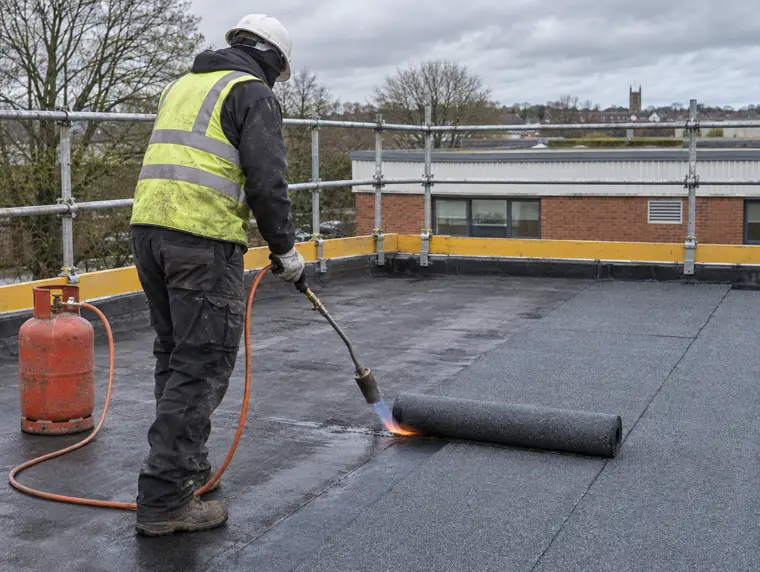
Choose torch-on felt when you want a proven, layered system at a sensible price, particularly on larger roofs, blocks of flats and commercial buildings where several layers give useful redundancy. It is a weaker choice where hot works are hard to manage safely.
For: generally lower cost per square metre; two or three layers, so a single defect in one layer need not cause a leak; tough mineral finish; long track record and a British Standard code of practice; repairs can be made with compatible materials.
Against: needs a naked flame unless a cold-applied or self-adhesive alternative is used; shorter typical life than EPDM or GRP; the finish is functional rather than decorative; more laps to detail than a single sheet.
On small domestic roofs near timber, EPDM avoids the torch entirely. GRP gives a harder, neater surface. For an overlay, a liquid-applied system is often simpler. Large commercial roofs may suit single-ply, and older buildings may suit mastic asphalt. See our comparison guide.
Does replacing a felt roof mean upgrading the insulation?
Usually, yes, when the roof is over a heated space and more than half of it is being re-covered. In England, Wales and Northern Ireland that is renovation of a thermal element, which should be brought towards the renovation U-value where feasible; a Scottish project goes through the council's building standards service, which confirms whether a warrant applies.
A felt replacement is a good point to switch to a warm roof, with insulation laid above the deck under the new membranes. On larger roofs, tapered insulation can also correct poor falls that have caused ponding, which a patch repair cannot fix. Raising the roof level affects upstands and door thresholds, so we check heights at survey. Any approval is arranged by us as part of the job, and the building regulations page sets out the rules by nation.
Which towns in Pembrokeshire do we cover?
Torch-on felt roofing in Pembrokeshire: questions
Which towns in Pembrokeshire do you cover?
All of Pembrokeshire. The main towns have their own pages below, and if yours isn't listed we still cover it: send your postcode and we'll confirm.
How much does a torch-on felt roof cost in Pembrokeshire?
£1,400–£2,400 for a typical 18 m² garage roof in torch-on felt, at Wales guide rates including VAT. The fixed price comes after a free survey for new and replacement roofs.
Which postcode areas do you cover in Pembrokeshire?
All of Pembrokeshire, including the SA postcode areas. Send your full postcode and we'll confirm.
How long does it take to lay a torch-on felt roof?
A garage roof typically takes one to two days and an insulated extension two to three. Larger roofs and blocks are phased over longer, with each area made weathertight before the team leaves.
Is torch-on felt better than the old felt roofs?
Yes, considerably. Modern torch-on membranes are polymer-modified and polyester-reinforced, laid in bonded layers, and typically last much longer than the older felt systems they replace.
Why does my felt roof have blisters?
Blisters usually form when moisture or air trapped beneath the felt expands in the sun. A few small, intact blisters may be monitored, but widespread or split blisters point to a repair or replacement.
Everything about torch-on felt roofing → · All flat roofing in Pembrokeshire →